Recommendations for open source
Maximize impact with European-led open source platforms
Open source platforms are a catalyst for collaboration: organizations can focus on building their products and services on top of existing platforms, rather than rewriting software from scratch and duplicating effort. Europe should pool its talents to co-develop industrial-grade, European-led platforms in open source as they have the potential to accelerate standardization and drive adoption.
The European Union (EU)’s robust research funding ecosystem presents an opportunity to maximize the impact of open source innovation if we embrace longer-term support. Too often, research efforts restart from scratch, and unintentionally result in “abandonware”, software that falls out of use when research grants expire. Public funding could be leveraged to reinforce collaboration around open source platforms if organizations are incentivized to extend existing platforms and if funding for new platforms is extended beyond the standard grant cycle to support projects to the point that they are sustainable, which usually requires five to six years.
Additionally, establishing a European sovereign technology fund could help support existing platforms, promote an “upstream first” collaborative culture, and empower communities to sustainably secure the critical digital infrastructure we all rely on.
Establish sovereign infrastructure for the software supply chain
Real digital autonomy requires immediate action to ensure that Europe has freedom of action regarding the software dependencies we rely upon. The current landscape features a critical vulnerability: package repositories and registries are all hosted and legally controlled outside of Europe – specifically, in the United States (US). Every time we build software in Java, JavaScript, Python, Rust, …, we download components from the respective package registries hosted in the US.
The risk is that if those registries were to become inaccessible, EU software would stop working. Establishing fully mirrored, European-hosted infrastructure for critical dependencies is a necessary step to mitigate geopolitical risks, export controls, and unilateral technology withdrawals. This sovereign infrastructure should be treated as a public utility, funded and maintained to ensure uninterrupted access to the building blocks of the modern digital economy.
Mandate open source application programming interfaces (APIs) for end-of-life consumer electronics
To combat e-waste and programmed obsolescence, regulators should mandate that consumer electronics manufacturers open source device APIs and technical documentation at product end-of-life (EOL). When proprietary cloud servers shut down, this requirement ensures devices can still be controlled locally rather than becoming useless. By empowering open source communities to maintain these abandoned systems, functional hardware gains a virtually indefinite second life. Ultimately, this protects consumer investments and leverages open source development to drastically reduce the environmental impact of digital products.
Bridge the gap between open source software and open source hardware
While open source software has a reproduction cost of zero, open source hardware faces huge capital expenditures for manufacturing. To support European semiconductor sovereignty, investment should support the creation of mature industry-grade RISC-V based designs, and beyond that, to secure open, end-to-end toolchains from electronic design automation (EDA) design to physical silicon.
Leverage open source to ensure digital sovereignty in the age of artificial intelligence (AI)
To ensure true digital sovereignty and prevent “open-washing”, policymakers should endorse the Open Source Initiative’s (OSI) Open Source AI Definition (OSAID). This requires that AI systems marketed as “open source” go beyond publishing “open weights” by mandating full transparency in training code, and detailed information regarding training data sources and preparation methods. Establishing this rigorous approach ensures that developers can genuinely use, study and modify these AI systems.
Furthermore, strategic initiatives should support the deployment of AI agents specifically designed to maintain, secure, and manage the growing influx of code contributions within the foundational open source ecosystems that power the AI revolution.
Background: Open source as an enabler in a software-defined reality
Fifteen years after venture capitalist Marc Andreessen announced that “software [was] eating the world” [1], software defines everything: cloud infrastructures, edge and internet-of-things (IoT) systems, automotive, energy grids, healthcare platforms, industrial automation, and even defence systems. In all these domains, the added value and the differentiation factors move decisively into software layers.
In such a world, relying exclusively on closed, proprietary software stacks for critical functions becomes a strategic risk. Given the European context, HiPEAC advocates open source as the basis for “software defined everything”, for the following reasons.
Open source software is fundamental to ensuring transparency, adaptability, and long-term sustainability. It allows organizations to clearly understand how their core infrastructure operates, tailor systems to specific local requirements, and evolve them independently. With open source, governments and organizations have the “freedom of action” to retain control over critical digital assets, while still participating in global innovation ecosystems. It reduces dependencies on single vendors or jurisdictions, mitigating risks related to export controls, or unilateral technology withdrawal. In summary, open source enables sovereignty and collaboration, allowing international partners to co-develop, audit, and evolve shared digital infrastructures.
Moreover, in today’s geopolitical environment, where software supply-chain audits are an important part of cybersecurity (as noted in the cybersecurity chapter of this HiPEAC Vision), open source provides transparency and collective oversight. Open source enables building on components which can be fully audited, reducing dependency on opaque systems. Managed open source software, backed by strong open source governance supported by open source foundations, enables secure collaboration across partners while preserving control over deployment and security.
Finally, with software-defined systems, open source can be an effective mechanism to enable interoperability across different vendors and sectors, enabling diverse ecosystems to seamlessly integrate rather than working in silos. The advantage of open source over open standards for interoperability is that with running code, integrators can either directly use the available code, which is the best case, or test their own version against the open source available version. This is particularly relevant for large-scale systems such as in the cloud-edge continuum (essential for the next computing paradigm (NCP) set out in this HiPEAC Vision), data spaces or mobility.
Licensing: The foundation of the open source ecosystem
Open source licensing is built upon the “four freedoms” of free software introduced by Richard Stallman in 1984 [2], which guarantee users the right to use, study, improve, and share software. This was later formalized for the broader industry in 1998 when the Open Source Initiative (OSI) published the Open Source Definition [3].
Today, while a number of distinct licences exist, the ecosystem has consolidated around a smaller number of heavily utilized standard licences. This makes software compliance far easier, even when components are mixed in a piece of software following licence compatibility.
Navigating this landscape can be complex, but excellent public resources are available. For instance, the European Commission has built a highly effective tool called the Joinup Licensing Assistant [4], which helps developers, users, and policymakers easily find, compare, and understand the implications of various open source licences.
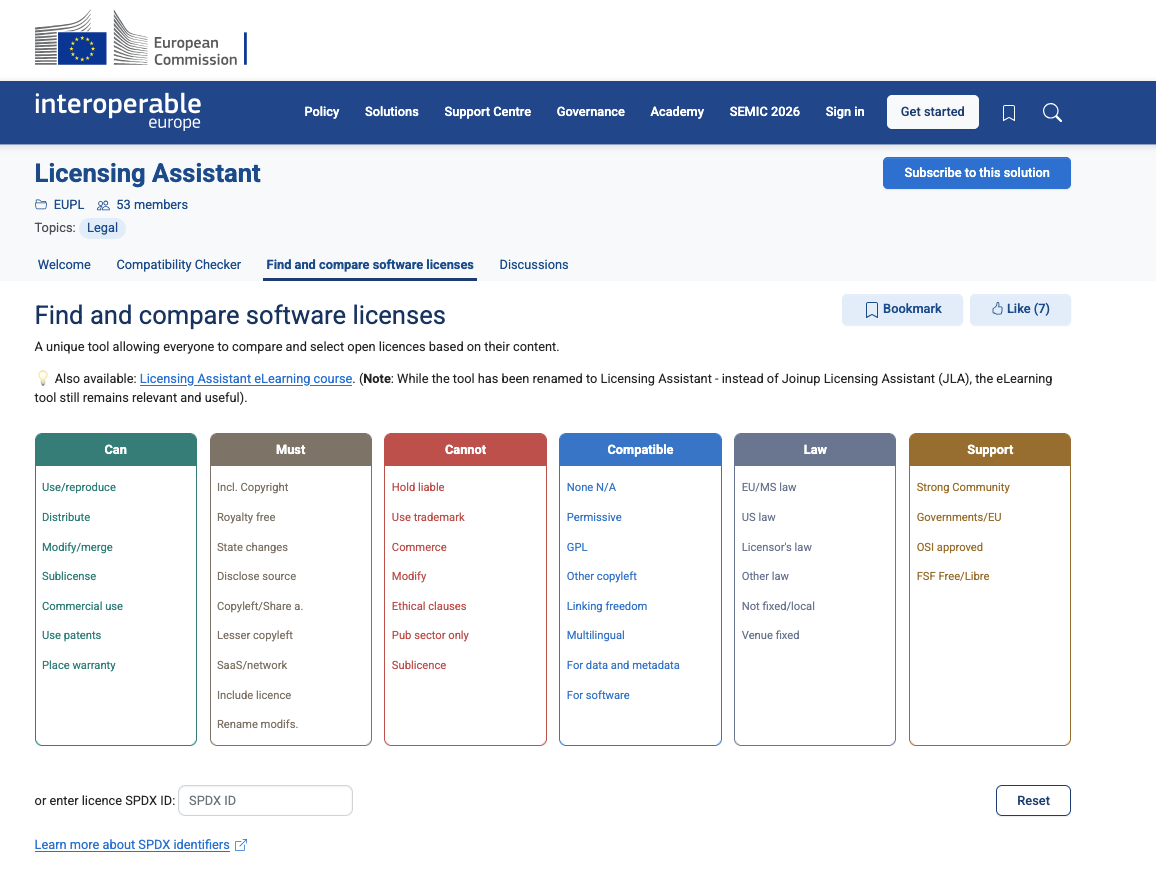
The way organizations approach licensing in 2026 is vastly different from how it was done 25 years ago. Selecting a licence can be seen sometimes as a philosophical declaration, but most of the time it follows a strong business and adoption strategy.
The current landscape can generally be understood through three main approaches:
- Permissive licences (MIT, BSD, Apache License 2.0): These are currently the most popular choices for new projects. They are widely favoured because they are universally accepted by the legal and compliance departments of large organizations, thus making it easier for developers when they want to use a project under such a licence. By imposing minimal restrictions, they ensure that projects can be easily adopted, modified, and integrated into different types of organizations, including proprietary commercial products, without friction.
- Strong copyleft (GPL and AGPL): The role of strict copyleft has shifted over the years. The GPL is used within a few established, powerful ecosystems like Linux and OpenJDK. It is also strategically utilized by governments and public-interest advocates to guarantee the principle of “public money, public code” [5], ensuring that taxpayer-funded software remains a permanent public asset by requiring any future modifications to be shared back with the community. Similarly, some large community-driven projects may rely on strong copyleft licences to actively shield their collaborative labour from corporate capture. Meanwhile, with the development of SaaS products, the AGPL has found a niche among vendors building open source products. These companies frequently use the AGPL to prevent cloud providers from offering their software as a service without contributing back, while most of the time offering a dual-licensing model to enterprise clients as an alternative monetization strategy.
- Weak copyleft (e.g., LGPL, EPL V2): For development teams who feel that permissive licences are too weak, but who still want to enable companies to integrate their project into products, “weak copyleft” licences serve as a pragmatic trade-off. Licences like the EPLV2 allow the open source components to be integrated into larger, non-open source products, but they strictly enforce the publication of any modifications made directly to those original open source files, thus incentivizing upstream contributions.
In addition to those well-adopted licences, the European Union Public Licence (EUPL) is unique because it was created primarily from a public policy and legal interoperability standpoint, rather than emerging organically from a developer community. As such, it remains less famous globally than licences like the Apache Software License that was initially attached to the Apache web server. To promote the adoption of the EUPL, a highly effective strategy would be to adopt dual licensing: by combining the EUPL with more popular licences, projects can appeal to a broader developer base while making the EUPL known to those developers.
The economics of open source: Platforms vs products
To better understand the dynamics of open source ecosystems, it is important to differentiate clearly between open source platforms and open source products. The economic incentives, adoption patterns, and strategic viability differ fundamentally, creating distinct challenges and opportunities.
The platform imperative
Open source platforms are foundational, infrastructural technologies used by virtually everybody, constituting more than 80% of all applications and digital services. This is the pre-competitive space where industry players can collaborate between peers, creating an open, transparent, and vendor-neutral community of enterprises of all sizes and researchers, all the way down to individual developers or students.
Technologies like Kubernetes in the cloud-orchestration space represent prime examples of such platforms. Eclipse Software Defined Vehicle (SDV), an initiative where representatives from the automotive industry are collaborating on digital transformation, demonstrates how such an approach can also apply to a specific vertical.
These platforms typically serve as base components for various types of downstream products, ranging from pure software applications to deeply embedded systems. The primary economic incentives for contributing to such platforms are cost-sharing, shorter time-to-market, and interoperability.
It is highly efficient for both large organizations and small enterprises to rely on open source platforms, rather than attempting to write a complex software system from scratch. Indeed, shared foundational components drastically lower the barrier to entry for small and medium-sized enterprises (SMEs) and startups, reduce industry-wide duplication of effort, and enable public and private actors to focus investment on unique technological differentiation rather than reinventing the wheel.
The open source product dilemma
The situation regarding open source products, understood as complete, deployable applications, is significantly more complex. Such products are either managed and commercialized primarily by a single vendor or considered as digital commons with strong support by governments.
Government-led digital commons
An interesting example of seeing governments investing in “digital commons” is happening across Europe, where a growing number of member states are taking active steps toward integrating open source productivity components to provide their public servants with their own productivity suite. France and Germany exemplify this trend, having developed platforms such as LaSuite [6] and openDesk [7] to serve as sovereign alternatives to proprietary software suites. They are assembling proven open source solutions, such as secure messaging and document collaboration, to provide the services needed by their users.
One strong requirement is that member states should align to make those alternatives interoperable. This could be reinforced at the European level through the Digital Commons European Digital Infrastructure Consortium (DC-EDIC), which should coordinate national projects from France, Germany, the Netherlands, and Italy and scale their national initiatives into a resilient European digital infrastructure.
The open source single-vendor dilemma
If we consider open source products supported by a single vendor, we have observed, in the last 10 years, a number of companies that achieved market success and widespread developer adoption thanks to an open source distribution model before eventually deciding to radically change their business and licensing models to maximize monetization. Noticeable examples include vendors such as Elastic, Redis, and MongoDB who have either abandoned their open source licences or switched to much more restrictive licences to adopt dual licensing approaches.
This abrupt transition deeply fractured the developer community, and, in most cases, such moves resulted in the creation of a fork hosted by an open source foundation like Open Search and Valkey, for Elastic and Redis respectively.
Despite these frictions, several European companies building efficient open source products like Nextcloud or Open-Xchange. Nextcloud [8] represents the “fer de lance” (spearhead) of this sovereign European movement: the company has reached a significant size by working exclusively in open source and selling annual subscriptions to larger users as well as addressing smaller users with a network of partners.
There is no one single open source business model
The fact that Nextcloud has implemented a business model that works for them and is sustainable does not mean that there is a specific “open source business model”, a business model that would guarantee an obvious path to revenue for open source companies.
Many believe that replicating RedHat’s business model, by providing enterprise-level support for an open source project, would be the best path. Unfortunately, rather than primarily providing support to Linux users, the RedHat business model, arguably, focuses mainly on managing the significant complexity of the Linux ecosystem. This was illustrated by their “Tried, Tested, Trusted” campaign: the Linux ecosystem represents >50000 packages; Fedora, the free distribution led by RedHat, integrates >5000 packages, and RHEL, RedHat Enterprise Linux, provides >1500 packages that are heavily curated, tested, and packaged, and come with round-the-clock enterprise support, security updates, etc.
More generally, open source experts claim that there is no open source business model [9] and position open source as a development and collaboration model, rather than a monetization strategy. Open source is indeed a highly effective methodology for decentralization, providing the legal and technical framework for organizations and individuals to pool resources, co-create running code, and solve shared problems without duplicating efforts. But when it comes to business models, each company has to build their successful business models on top of or around open source projects. Their value proposition can leverage packaging software products, integrating open source software in a “product”, from a simple IoT gadget to a car, or offering services in different forms like support, expertise, training, or hosting.
Three strategic approaches to open source
As discussed in the previous section, there are many different approaches to open source, depending on the kind of organization, their positioning in the software value chain, and their goals. Below are three distinct operational models that are particularly powerful.
Industry collaboration to build pre-competitive platforms.
Industry players collaborate on pre-competitive platforms that support their shared requirements. By pooling resources rather than operating in silos, companies save massive amounts of money. In domains like automotive (see Eclipse SDV), this is directly helping European actors accelerate their digital transformation. Beyond this acceleration, positive externalities include fostering innovation, lowering barrier to entry for SMEs, and showing global technological leadership.
Universities accelerate take-up
Through open source, researchers can increase industry adoption of their results in three ways:
- they can collaborate with large organizations that have mastered the art of using open source software;
- they can collaborate with fellow researchers around an open source research platform; and
- they can enable collaboration via a potential spin-off.
In each case, open source facilitates the collaboration on software artefacts without hindering the capability to maintaining close ties between their labs and their partners through contracts intending to get access to unique skills, or to license non-open source assets.
However, current project-based research funding incentivizes the launch of new initiatives over contributing to an existing platform. This sometimes results in “abandonware”: software projects dumped as open source onto public repositories to satisfy commitments in a grant agreement. To fix this we should incentivise contributions to existing platforms, invite researchers to embrace and extend existing ecosystems rather than reinventing the wheel, and support the evolution and maintenance of established open source platforms through specific funding instruments.
Government supporting digital commons
As illustrated above, governments can fund digital commons released as open source digital public goods. This can be well adapted to initiatives that intend to provide foundational software for the citizens or public servants. However, the primary strategic risk is the naïve expectation that a developer community will magically jump to support these commons. Creating a community requires considerable maturity from an open source project: the project must be usable and useful, and requires significant time and effort until the network effect starts playing a role in driving adoption and supporting sustainability. Governments should take this into account and plan to sustain these open source digital commons in the long run, retaining the capability internally or externally to maintain and promote them.
Digital sovereignty and open source supply-chain control
Open source fundamentally moves the needle away from negotiating restrictive commercial agreements with foreign software vendors and towards developing the technical skills to run, maintain and independently modify the software. The secret power of open source when it comes to digital sovereignty is the ability to “fork” a project, taking a complete copy of the source code and developing it independently, in the event that the geopolitical situation requires this, or if a dominant vendor introduces hostile, extractive licensing changes.
However, exercising this sovereign capability requires a strong commitment to addressing a few systemic risks. The most important one is certainly the severe geographical centralization of code hosting and software distribution. Most critical open source projects are hosted outside of Europe, and almost all foundational package repositories are hosted and legally domiciled in the United States (US) [10].
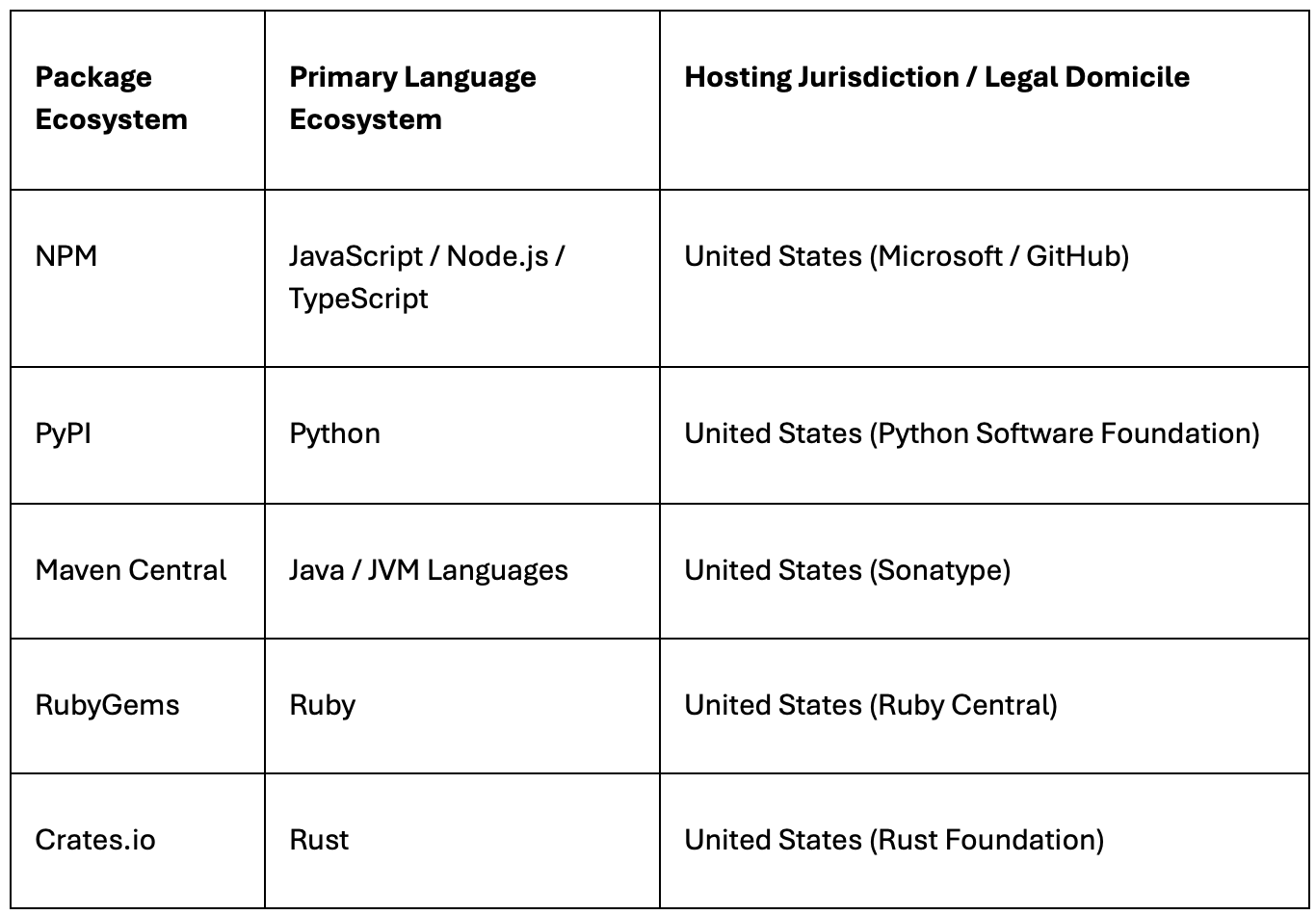
When people have in mind the concept of a “kill-switch”, they often think that a foreign service provider could be instructed to stop providing their services in Europe. But the fact that literally all software built in Europe relies on components pulled from foreign-hosted infrastructure is an oversight. There are potential scenarios where European industry could rapidly lose access to the daily updates, critical security patches, and raw code libraries critical to build and maintain modern software.
Real, actionable digital sovereignty, therefore, would likely require immediate, significant initiatives to ensure that Europe has absolute freedom of action regarding all the software dependencies the bloc relies upon. This includes funding and maintaining high-availability European mirrors of the main package repositories. (A discussion of these issues can also be found in the article “Europe’s need for digital essentials, individual sovereignty and consumer protection” in the HiPEAC Vision 2023.)

Open source as an enabler of sustainability
Beyond fostering industry collaboration, building solid software architecture and resilience to geopolitical shifts, open source can also play a role in empowering consumers as an enabler of sustainability. Specifically, open source is part of the solution against the ecologically devastating practice of programmed obsolescence.
As the most effective way to reduce the overall environmental impact of consumer information technology (IT) systems is to extend their operational lifespan, open source enables a community of users and developers to take over the maintenance and operation of a hardware product when this product is formally abandoned by its original producer, or if the producing company goes bankrupt.
In some cases, perfectly capable physical hardware is instantly transformed into useless plastic bricks, forcing the artificial obsolescence of functional devices, and requiring consumers to purchase replacements to maintain the functionality they originally purchased. However, this is not inevitable. An illuminating contrast in corporate behaviour perfectly highlights this dynamic.
Google has faced significant controversy [11] for deciding to retire older Nest smart-home hardware. By unilaterally shutting down the proprietary cloud servers and APIs required for the devices to function, their smart thermostat was instantly transformed into a simple, non-connected thermostat.
In contrast, the audio manufacturer Bose took an entirely different approach towards their ageing SoundTouch home theatre smart speakers [12]. Recognizing that they could no longer sustain the proprietary cloud infrastructure powering the decade-old product line, Bose actively chose to prevent their hardware from becoming unnecessary e-waste. Ahead of the final end-of-life (EOL) date, Bose officially published and fully open sourced the SoundTouch Web API documentation, allowing the devices to be fully controlled via local area networks without any reliance on external internet servers. This responsible corporate action triggered a massive influx of open source repositories and community-driven integrations. It allowed developers to seamlessly integrate the ageing speakers into local smart home orchestrators like Home Assistant, writing custom Python libraries to maintain full control over playback, volume, and multi-room grouping.
By opening the technical specifications, Bose enabled the community to recreate cloud features locally, giving the hardware a functional, virtually indefinite second life. This protected consumer investments and drastically reduced unnecessary embodied emissions. This model proves that open sourcing device APIs at the end of a product’s commercial life cycle is a highly effective sustainability measure that should strongly be considered as a mandated regulatory standard for consumer electronics across the European Union.
Bridging the gap between open source software and open source hardware
Despite noticeable momentum, the operational dynamics of open source hardware differs fundamentally from open source software. While software reproduction costs are close to zero, transitioning from digital logic to manufacturing physical silicon chips is exceptionally expensive. A single logic bug discovered post-fabrication requires a physical “re-spin” that can cost millions of euros and delay projects by months. These differences demand that open source hardware is built differently from open source software. While software can be immediately tested in real conditions, open source hardware design must endure robust verifications and simulation phases before production of the first chip can start, a process in itself that can span several months.
Expanding European Leadership in RISC-V
The strategic push for European digital sovereignty extends beyond software into the complex realm of hardware. Europe is building a robust open source hardware ecosystem, driven by the rise of the RISC-V open standard instruction set architecture (ISA). Supported by prominent researchers and heavily backed by the European Commission with projects like TRISTAN, Isolde, Rigoletto, and Turandot, as well as the European Processor Initiative (EPI), EUPILOT, eProcessor, and DARE in the high-performance computing space, this ecosystem is rapidly advancing through highly capitalized initiatives. Thanks to these initiatives, open source hardware projects like CVA2 and CVA6 are reaching higher technology readiness levels (TRLs), as they benefit from dedicated resources committed to verification activities.
This results in industry-grade open source cores, hosted by the OpenHW Foundation, under the auspices of the Eclipse Foundation AISBL, based in Europe – for example, those made available as part of the European Unified RISC-V IP Access Platform spearheaded by TRISTAN. Such RISC-V cores provide designers with a reliable starting point to build sovereign silicon. As part of these projects, the European ecosystem is committed to demonstrate how such cores can be used in automotive use cases, and to provide an end-to-end open source solution from silicon to automotive middleware.
In this domain, Europe demonstrates that adequate funding, mixed with a strategic open source approach, can support industry by providing technology building blocks that save considerable time and money as organisations move from an idea to a finished product. However, it should be noted that a component like CVA6 is still a low-level component, and is insufficient on its own to produce processors; it is necessary to integrate a few cores with additional intellectual property blocks (IPs) to build a central processing unit (CPU) that can run Linux. In addition to continuing to build such components, it is important to incentivize industry players to create larger open source hardware systems.
From open source hardware design to producing chips
To enable the shift from design to testing production, the next practical step is to work in collaboration with leaders of such open source chip designs and production facilities. The entire toolchain should be made available, including encouraging European fabs to open their process development kit (PDK) so that it is easier to process and prepare for actual production of chips in European production facilities.
This collaborative approach will help ensure that Europe has the skills, and the intellectual property to support and shield its industries from the side effects of geopolitical or trade issues. This is easily illustrated by the late 2025 incident with Nexperia [13] when a dispute between Nexperia’s Chinese subsidiary and the Dutch parent company, initially triggered by Dutch government intervention, severely disrupted the global automotive supply chain that relies on their components. European carmakers are now warning of critical supply shocks, with several manufacturers forced to slow down vehicle production, highlighting the vulnerability of global automakers to the growing regionalization of the semiconductor industry driven by geopolitical tensions and technology restrictions.
The case for open source EDA tools
EDA tools are the complex suite of applications required to design, simulate, and verify integrated circuits before fabrication. Currently, open source EDA toolchains suffer from technology limitations and lack the “correct-by-construction” reliability needed for leading-edge, industrial tape-outs. To achieve true semiconductor sovereignty, Europe should strategically invest not only on open processor designs, but also in maturing open source EDA toolchains to bridge the gap with the oligopoly of design tools, the majority of which are from US actors.
EU procurement also has a role to play in promoting open and diverse hardware in European computing infrastructures. For example, in an open letter [14], ADRA (the European AI Robotics Association) called for the EU’s AI Gigafactory initiative to ensure that diverse hardware, including designed-in-Europe chips, can be used in future AI Gigafactories.
ADRA warns that proprietary toolchains, networking monopolies and optimization layers result in vendor lock-in. Their proposal calls for a “resilience” scoring module in the evaluation of bids, which should favour:
- support for non-proprietary standards such as ONNX, OpenXLA, and SYCL as the baseline for interoperability;
- the inclusion of open networking as a criteria for evaluation; and
- bids that include local European partners and onshore supply chains.
The AI frontier: Sovereignty in the age of agents
AI builds on a strong open source heritage
The current AI revolution is deeply rooted in open source frameworks. Technologies with a strong European heritage, such as ScikitLearn [15], alongside ecosystems like PyTorch and Python, form the foundation of modern machine learning. We are now witnessing a powerful compounding effect: new projects like OpenClaw [16] are being rapidly co-developed with AI assistance, then released as open source to leverage frictionless, global adoption.
It is interesting to observe that the development of AI infrastructure and tools functions much like traditional open source software projects.
AI LLMs, specifically those focused on coding, are already having an influence on the development cycle of open source projects, as they drastically reduce the time required to build new tools. Moreover, AI also reduces the cost of contributing to open source – to the point that maintainers are drowning under the amount of low-quality AI-powered contributions they receive for their project. On the bright side, the best AI models in terms of coding are now used to detect security issues in open source projects [17] (see the cybersecurity chapter in this HiPEAC Vision for a detailed discussion of AI-powered vulnerability detection and cyber defence).
Extending these trends, we can see how AI agents could become the “magic community” that helps maintain open source projects, if developers can keep up with the increasing flow of AI driven contributions. AI agents could also enable companies to create private forks of projects, corresponding to slight customization that may not seem useful to the larger community.
What is open source AI?
Although the tooling components of AI – which are regular software – are published as open source, this is a bit different for models. Target the widest possible adoption, many models are published as open weights, under an open source licence, enabling free usage. One noticeable exception is Llama: despite being advertised as “open source” by Meta, it was never published under a licence that complies with the open source definition as set out by the Open Source Initiative (OSI) [18].
Beyond the open source definition that applies only to software, since 2023 the Open Source Initiative has worked intensively on what it means for an AI system to be open source, starting from the initial principles that users should be able to run a system without restriction, to study it, to modify it, and to share it, to be able to call it open source. This resulted in the publication of the Open Source AI Definition v1.0, which describes the different aspects of an AI system: the code to train and execute the model, the training data, as well as the code and instructions to prepare the training data. The OSAID expects that all software be open source, but for the training data, following a long investigation around copyright considerations for AI data sets, the OSAID requires only the publication of data information, which is the list of data sources, and how the different pieces of data are selected and prepared before training. As AI is evolving fast, and as the understanding of the open source community is maturing, the OSAID definition will continue to evolve in collaboration with the community.
Reflections on OpenClaw and digital sovereignty
The recent trajectory of OpenClaw, a highly successful AI agent, is exemplary of the articulation of open source and AI ecosystems. The project was authored with help from AI code generation by an independent Austrian developer and released as open source. After achieving viral global adoption, the project’s creator was hired by OpenAI to lead their personal agents division. While accompanying press releases [19] promised that OpenClaw would transition into a foundation and still be sponsored by OpenAI, this case highlights the scenario where dominant tech companies can simply absorb top talent through massive financial incentives and therefore de facto take control of the code.
To ensure the critical technology automating our future remains genuinely independent and transparent, Europe must proactively fund and protect sovereign digital commons, independent foundations, and individual researchers to preserve a truly open AI ecosystem.
Why Software Is Eating the World - Marc Andreessen – August 20, 2011 - https://a16z.com/why-software-is-eating-the-world/↩︎
Four freedoms – free software See https://fsfe.org/freesoftware/↩︎
The Open Source Definition - https://opensource.org/osd↩︎
The Joinup Licensing Assistant https://interoperable-europe.ec.europa.eu/collection/eupl/solution/licensing-assistant/find-and-compare-software-licenses↩︎
Public Money, Public Code campaign - https://publiccode.eu/en/↩︎
Nextcloud Business Model - https://youtu.be/yes6NhdBFfw?si=494-BC8u4LiDCO6j&t=910↩︎
There is Still NO Open Source Business Model – October 17, 2018 - Stephen Walli - https://medium.com/@stephenrwalli/there-is-still-no-open-source-business-model-8748738faa43↩︎
The Dependency Layer in Digital Sovereignty – Andrew Nesbitt – Jan 28, 2026 - https://nesbitt.io/2026/01/28/the-dependency-layer-in-digital-sovereignty.html↩︎
Upcoming end of support for Nest Learning Thermostats (1st and 2nd gen) - https://www.reddit.com/r/Nest/comments/1k7qepg/upcoming_end_of_support_for_nest_learning/↩︎
Bose open-sources its SoundTouch home theater smart speakers ahead of end-of-life – January 7, 2026 - https://arstechnica.com/gadgets/2026/01/bose-open-sources-its-soundtouch-home-theater-smart-speakers-ahead-of-eol/↩︎
European carmakers warn of supply shocks as Nexperia halts chip exports to China - https://www.euronews.com/business/2025/10/31/european-carmakers-warn-of-supply-shocks-as-nexperia-halts-chip-exports-to-china↩︎
ADRA releases an open letter for AI Gigafactory infrastructure to adopt open software - https://adr-association.eu/news/adra-releases-open-letter-ai-gigafactory-infrastructure-adopt-open-software↩︎
Scikit-learn Central - https://scikit-learn-central.probabl.ai/↩︎
OpenClaw creator Peter Steinberger joins OpenAI – February 15, 2026 - https://techcrunch.com/2026/02/15/openclaw-creator-peter-steinberger-joins-openai/↩︎
Anthropic’s Claude Code Security is available now after finding 500+ vulnerabilities: how security leaders should respond – February 23, 2026 - https://venturebeat.com/security/anthropic-claude-code-security-reasoning-vulnerability-hunting↩︎
Meta’s LLaMa license is still not Open Source – February 18, 2025 - https://opensource.org/blog/metas-llama-license-is-still-not-open-source↩︎
OpenAI Acquires OpenClaw: Inside the Viral AI Agent That Caught Big Tech’s Attention - https://www.leanware.co/insights/openai-openclaw-acquisition↩︎