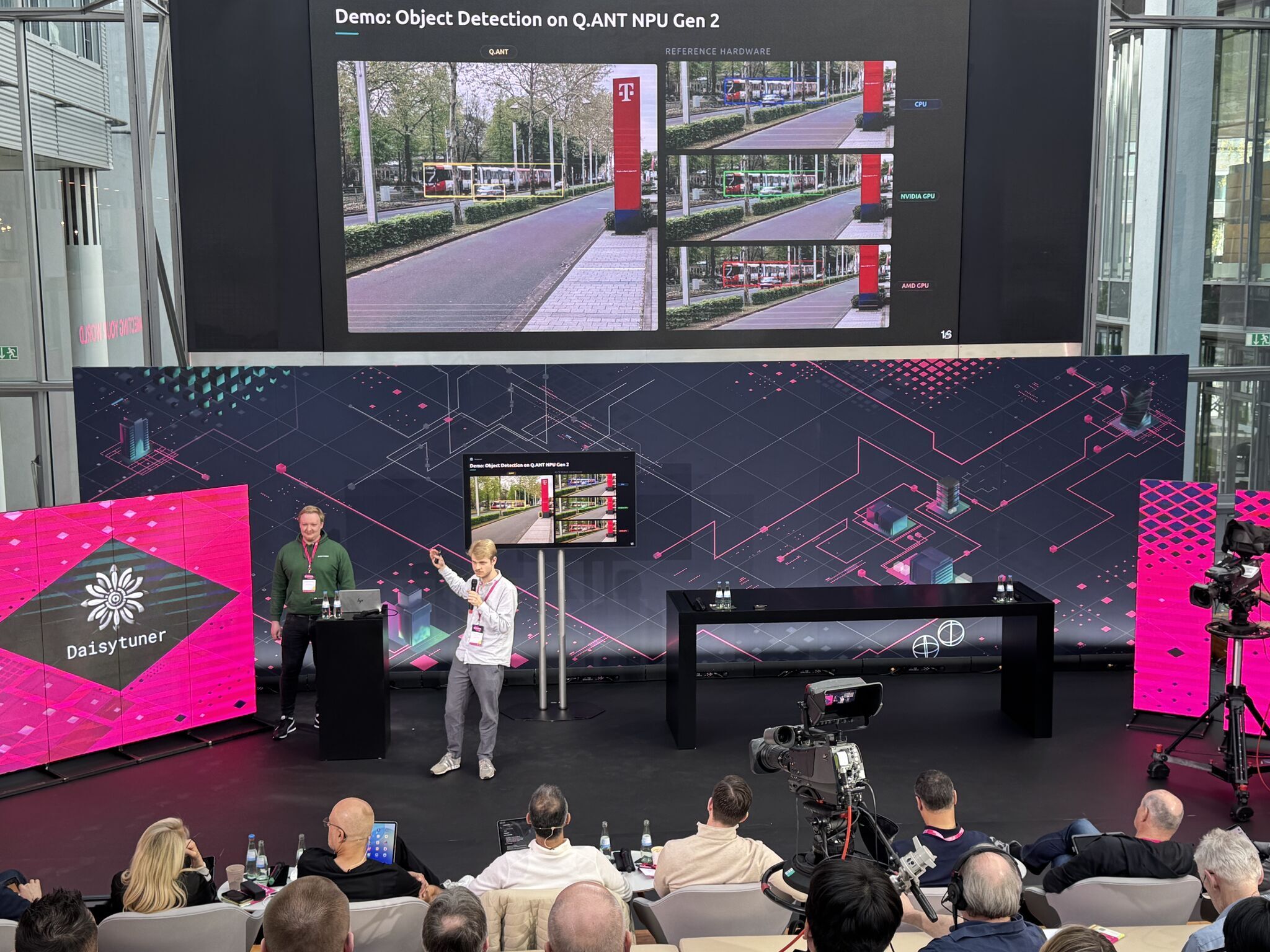
According to Daisytuner’s announcement, Adrian Schmitz and Moritz Timmer from the company presented speedups for object-detection workloads running on graphics processing units (GPUs), achieved without manual tuning. Next, in a live demonstration, they showed how Daisytuner enables performance portability to new hardware, showing the unmodified model running efficiently on a completely different hardware target: a photonic neural processing unit (NPU) from the German company Q.ANT. The model was compiled and executed via Daisytuner’s software stack with no changes to the PyTorch code.
Daisytuner’s software-optimization platform is designed to automatically compile, tune, and run applications across different hardware processors, without application developers having to adapt their code. The company, which is based in Darmstadt, Germany, built its technology on the foundations of the Data-Centric Programming (DaCe) framework developed in HiPEAC member Torsten Hoefler’s Scalable Parallel Computing Lab at ETH Zürich.