 As the global energy sector undergoes a profound transformation towards decarbonization, digitalization, and decentralization, the way we manage, optimize, and secure energy systems is being reshaped. In this article,
 Traditional centralized control models are no longer sufficient to handle the complexity of modern grids, which must integrate renewable sources, electric vehicles, local storage systems, heat pumps and dynamic consumer behaviour. The April 2025 blackout in Spain and Portugal showed that central and rigid control systems cannot deal with fluctuations and disturbances of increasing volatile energy assets.
In addition, today’s energy infrastructure is reaching its capacity limits and often operates close to saturation. This results in delays in accommodating new connection requests from solar and wind plants, heat pumps, electric vehicle (EV) charging infrastructure, and industrial sites. Distributed computing and decentralized intelligence are emerging as the backbone of Europe’s future decentralized energy system, enabling more resilient, efficient, and adaptive energy systems.
From centralized control to distributed intelligence
Historically, energy systems were designed around a centralized architecture: large-scale power plants generated electricity, which was transmitted and distributed to passive consumers and provided inertia to stabilize the grid. Decision-making and control were concentrated at the top of the hierarchy, with little or no autonomy at the local level.
Today, however, the rapid adoption of distributed energy resources (DERs) – such as rooftop solar, community batteries, and microgrids – has fragmented the grid into a highly dynamic ecosystem involving multiple actors and stakeholders. This shift demands new computational and organizational approaches in which computing is distributed closer to where decisions must be made.
Edge computing can be defined as ‘the practice of processing data near the source of generation, rather than relying on a centralized data processing cloud infrastructure’. According to a recent study by DECISION, Europe has a major opportunity in industrial internet-of-things (IoT) edge computing, projected to generate nearly €88 billion in global growth by 2027.
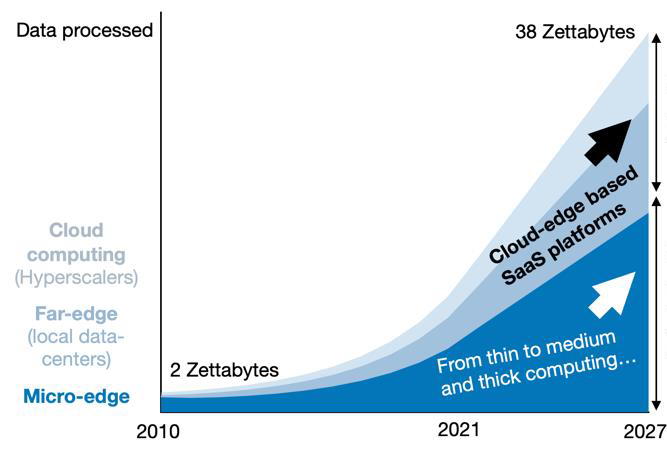 Credit: DECISION Étude & Conseil, APL Datacenter, 2023
European initiatives: MetaOS for energy
The MetaOS project initiative supports the implementation of the European Strategy for Data across the IoT, edge, and cloud continuum. MetaOS research and innovation projects, supported under Horizon Europe with a total of €60 million in funding, have spearheaded the implementation of novel edge-computing paradigms and have established a technology baseline for emerging trends like AI powered IoT and decentralized intelligence.
The notion of MetaOS emerged as a new concept for software-defined systems. In contrast to a standard operating system (OS), a MetaOS enables an abstraction from underlying computing and physical resources (like electronic control units) and hides the complexity of managing low-level control functions. To capitalize on the new edge paradigm and the next wave of innovation, the MetaOS cluster has brought together the development of IoT-edge nodes with the deployment of next-generation computing components, systems and platforms.
These advances enable the transition to a compute continuum with strong capacities at the edge and far edge, delivered in an energy-efficient and trustworthy manner.
An EnergyOS concept has been developed and predominantly deployed at the edge of the power grid to meet the needs of smart-grid users and achieve secure, efficient, and low-latency data processing. Several companies are now commercially exploiting products based on these developments, for example in substations that serve as critical components of distribution grids. Edge computing introduces local computing resources at the substation and field-asset level in an electrical grid. It is about virtualizing system functions and moving from closed, proprietary hardware, to an open, secure, interoperable software-defined platform, on which utility companies can build their own use cases (to find out more, see the EUCloudEdgeIoT paper Market Pathways for Cloud Edge IoT in Energy.
A digital backbone building on emerging energy-efficient AI models
At the heart of the energy transition lies the integration of highly volatile dynamic energy assets like solar, wind, EVs, heat pumps, buildings and other flexible loads, which extend beyond the energy domain. Future energy system operators increasingly need to act as orchestrators of interconnected ecosystems, seamlessly integrating energy flows and managing flexibility of distributed energy resources to manage demand and response.
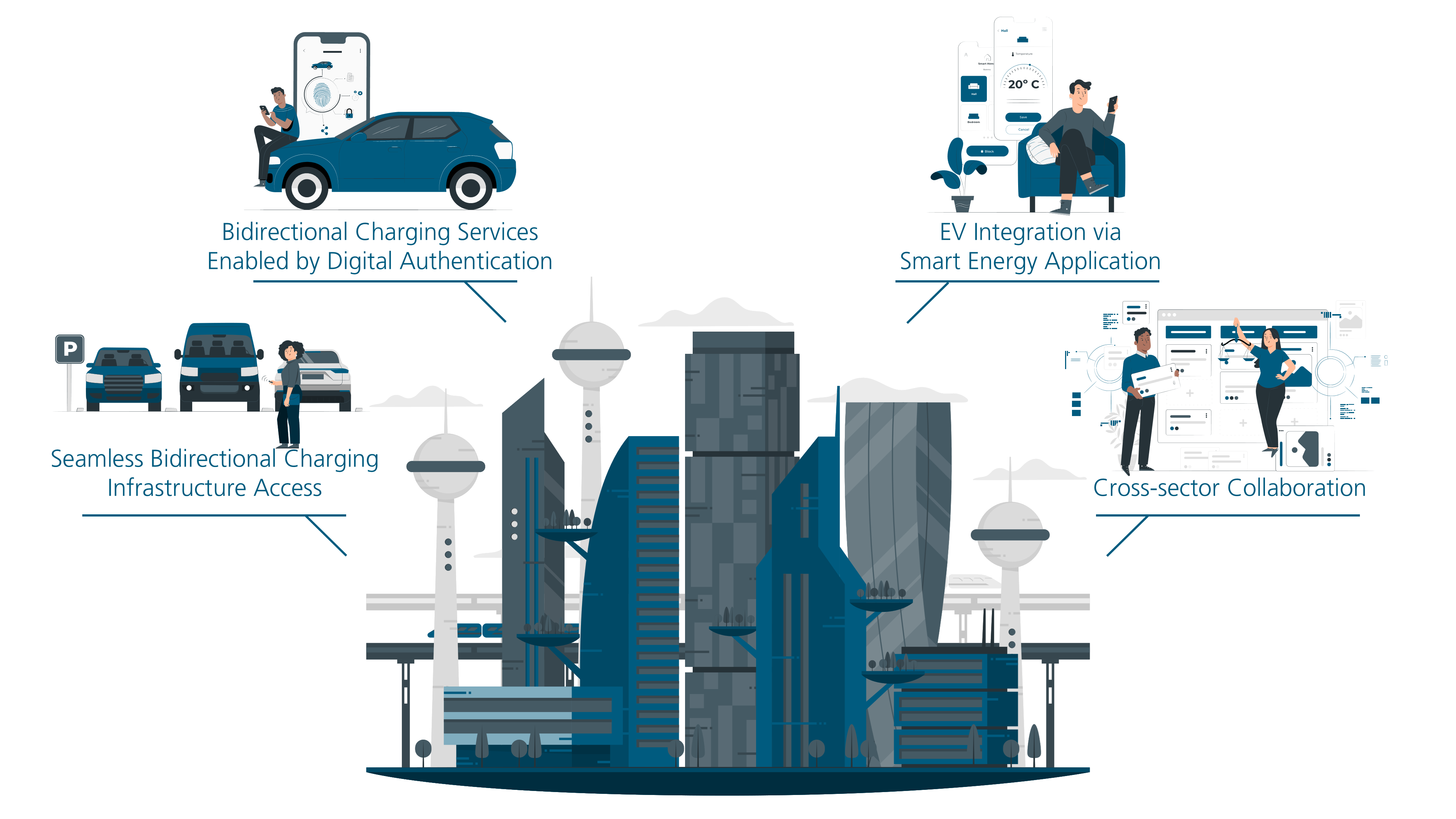 From Leveraging Twin Transformation: Digital Infrastructures to Advance Decarbonisation at the Nexus of Energy and Mobility, Fraunhofer FIT, 2024. Credit: Fraunhofer FIT
Asset orchestration goes beyond simple responsiveness and takes into account the dynamic collective behaviour of groups of distributed energy assets. Achieving real-time orchestration requires highly efficient AI models, decentralized computing and AI integrated at the grid edge. Such decentralized, energy-efficient AI is emerging as a digital backbone for transformative change – enabling systems that can anticipate, adapt, and act in real time. This leap in autonomy equips energy companies to manage complexity at scale, from volatile markets to distributed energy systems.
The European Commission (DG CNECT) supports the development of an AI-powered digital spine as part of the Horizon Europe Work Programme. This aims to manage the uncertainty of volatile energy flows and enable smart energy operations of energy assets such as heat pumps, electric vehicles, home batteries, and solar generation etc.
Future outlook
Distributed computing and decentralized intelligence are pivotal in addressing the energy sector’s challenges – rising demand, grid reliability and resilience, and renewable integration. Agentic AI technologies have the potential to address the energy trilemma of securing supply, reducing emissions, and mitigating infrastructure costs. As energy systems evolve into more participatory, decentralized networks, distributed computing and decentralized intelligence will be essential. Ultimately, the vision is a self-organizing, intelligent energy ecosystem in which millions of actors – consumers, devices, and algorithms – collaborate seamlessly to deliver clean, affordable, and reliable energy for all.
The transition to distributed computing and decentralized intelligence represents more than just a technological shift; it is a structural rethinking of how we design and operate energy systems, and it also embraces innovation from adjacent sectors. Establishing a digital backbone for the energy system will enable the distribution of both computing power and intelligence across the network, and will provide a quantum leap in the digitalization of energy systems, making them adaptable to the needs of the 21st century. Support is provided under Horizon Europe for the development of an AI-powered ‘digital spine’ as a key element of a digital backbone, expected to break down existing silos between the energy and mobility sectors, creating a seamless, interconnected system.
Further information
DECISION, 2023. Study on the economic potential of far edge computing in the future smart Internet of Things
EUCloudEdgeIoT, 2024. Market Pathways for Cloud Edge IoT in Energy
Fraunhofer FIT, 2024. Leveraging Twin Transformation: Digital Infrastructures to Advance Decarbonisation at the Nexus of Energy and Mobility
 This article originally appeared in HiPEACinfo 76, October 2025