

Technological sovereignty is a key strategic priority for organizations and governments around the world. Underpinning the digital products that drive modern economies, open-source semiconductor IP is increasingly seen as essential to technological sovereignty, enabling stronger collaboration, and more resilient innovation.
The new European Unified RISC-V IP Access Platform (UAP), created by the TRISTAN consortium and hosted by the OpenHW Foundation (an industry collaboration with the Eclipse Foundation), provides a single source of verified, industry-ready RISC-V components under various licences from TRISTAN, ISOLDE and other European research projects. The UAP is designed for engineers, researchers, startups, and established semiconductor teams who need reliable RISC-V IP with clear licensing and maturity information.
While development is ongoing, the UAP already includes multiple software and hardware components that any end user can adopt, marking an important step toward European technology sovereignty:
- Hypervisor support for CVA6 that follows the RISC-V hypervisor extension
- A Yocto-based Linux image for CVA6 processors
- An eXtension InterFace (CV-X-IF) to add custom accelerators into CVE2 RISC-V Cores
- Trace extensions for CVE4
- ELinOS embedded Linux for RISC-V, which includes the CODEO IDE for building industrial-grade embedded solutions
‘The Unified RISC-V IP Access Platform is one of the most important initiatives to come from the TRISTAN project, ensuring that the contributions from consortium partners continue to have impact on the European stage long past the end of our funding. Critically, it enables us to build and nurture a community around European RISC-V that will drive ongoing innovation and collaboration that supports European technological sovereignty,’ commented Rob Wullems, innovation strategist at NXP Semiconductors GmbH and the TRISTAN project lead.
From research to industrial adoption
The European Union sees RISC-V as a strategic lever for technological sovereignty and greater competition in the global semiconductor market, now worth roughly USD 700 billion. While the EU currently represents about 10% of this market, the 2023 European Chips Act aims to double Europe’s share to 20% by 2030.
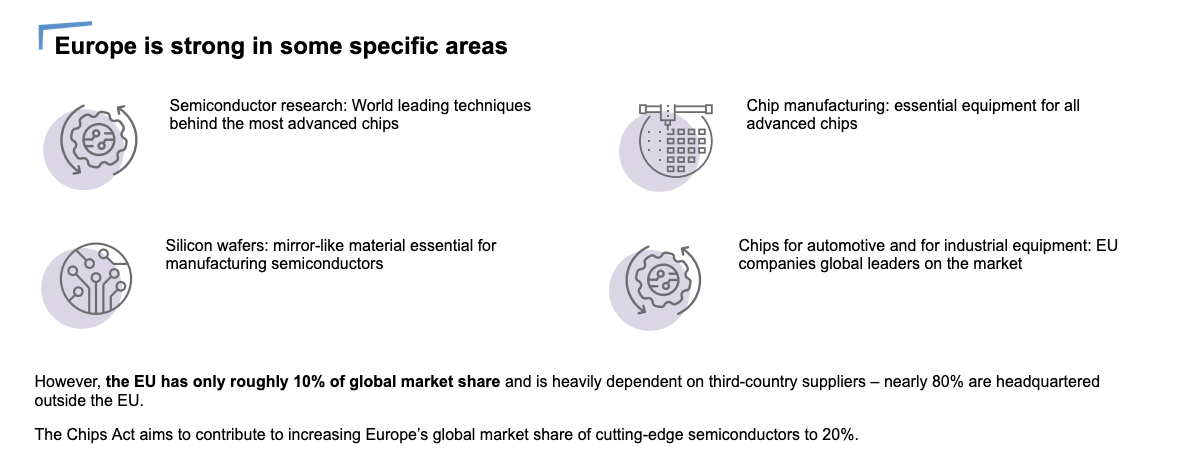 Extract from the Chips Act factsheet
However, when it comes to semiconductors, achieving technological sovereignty is anything but straightforward. Indeed, the recently published paper ‘Improving Chip Design Enablement for Universities in Europe’ identifies multiple barriers to entry, including costs, legal constraints, and access restrictions. The paper also notes a key gap: too little semiconductor IP is developed and maintained in Europe.
European research projects such as TRISTAN and RIGOLETTO play a vital role in advancing Europe’s semiconductor capabilities. But these are not without challenges. These projects have historically delivered strong technical results, yet many have struggled to achieve market adoption after the project ends. Alongside, short project timelines make it difficult to build communities that can maintain and evolve resulting IP.
The UAP addresses this by giving developers and organizations a single place to find verified, industry-ready RISC-V components developed in Europe.
A shared catalogue to keep European IP thriving
The UAP acts as a static unified access page, pointing to repositories hosted on the OpenHW Foundation GitHub, automatically mirrored to a European-hosted GitLab instance and to other public forges, or maintained as private assets. As an evolving structure designed to better support integration across toolchains, accelerators, and infrastructure components, the UAP provides a clear view of each item’s maturity, usability, licensing and integration workflow, including documentation, and status information.
The UAP is overseen by the Virtual Repository Task Group, which includes representatives from TRISTAN and ISOLDE. Other Chips JU and RISC-V-related EU projects such as Rebecca, RIGOLETTO, and Scale4Edge have begun to join. As more EU projects open-source their IP, they will be added as maintainers so that each project can curate its own catalogue and ensure continuity beyond the end of TRISTAN.
More features are planned for the UAP, including KPI-based adoption tracking, extended interoperability matrices, improved tooling, and long-term community development.
‘The Unified RISC-V IP Access Platform is absolutely critical to supporting technological sovereignty in Europe, and the OpenHW Foundation and Eclipse Foundation are committed to developing it into a sustainable, interoperable, and community driven resource for the wider RISC-V ecosystem. Open-source collaboration is essential to ensuring a competitive playing field, and by working together, we will be able to go further, faster,’ said Gaël Blondelle, chief membership officer at the Eclipse Foundation.
From EU research output to industry adoption
TRISTAN (Together for RISC-V Technology and Applications), which launched in 2023, aims to industrialize RISC-V cores – taking them from the lab to the real world, creating a sustainable open-source ecosystem to drive competitiveness and enable more agile innovation in Europe.
The TRISTAN consortium is a diverse group of 46 partners representing a wide range of stakeholders, from household-name organizations and small- and medium-sized enterprises, to research organizations, universities, and industry associations connected to RISC-V. Together, they catalyse expertise and resources from across Europe and beyond to drive innovation and collaboration in the field of RISC-V technology.
The TRISTAN project has resulted in a variety of RISC-V cores, from deeply embedded and microcontroller-performance cores, to verified application-ready cores. Multiple critical peripheral semiconductor IP has been developed, including for debug, trace, interrupt controllers, and hypervisor support. Alongside, software and simulators have been contributed by a variety of consortium partners.
Live now: how to access and contribute to the UAP
The UAP is now live, featuring both open source and proprietary RISC-V IP from TRISTAN, ISOLDE, Rebecca, and Scale4Edge. If you’re building semiconductor products, we encourage you to explore the catalogue, leverage European RISC-V IP where it fits, and contribute back to strengthen the ecosystem.
Florian (Flo) Wohlrab is the head of the OpenHW Foundation, an international non profit organisation dedicated to curating and maintaining high-quality, industrial-grade open source RISC-V Cores. Flo is fascinated by RISC-V and is dedicated to increasing access to high-quality RISC-V IP and promoting the RISC-V ISA worldwide. Alongside, he is also one of the first RISC-V International Ambassadors. Before leading the OpenHW Foundation Flo was head of sales for a commercial RISC-V provider where he focussed on markets in Japan, Europe and Middle East.