
What are the pitfalls of relying on technological infrastructure from other parts of the world?
Many European organizations need to use technological infrastructure that spans different continents. The cloud-edge continuum is also a geographical continuum that has to be able to offer infrastructure resources on demand wherever they are required. However, we need to offer industrial users a secure way to use resources from different cloud and edge providers without having to rely on proprietary platforms or fall into critical dependencies or vendor lock-in situations – like the ones we are currently witnessing with hyperscalers. That’s where strategic autonomy in the digital sector comes in.
How do you define ‘digital sovereignty’?
As we are discovering lately, digital sovereignty involves many different aspects in our daily lives, and it is a concept that has profound implications for the way in which our democracies and institutions operate. Technology, in that sense, is just a means – a means that can be used to exert influence and coercion on others, or a means to make sure one can make decisions in an autonomous manner, with no fear.
The main challenge that we have in Europe right now when it comes to digital sovereignty is the need to, once and for all, tackle the dependency complex that we suffer collectively. For decades, Europeans have assimilated a mentality that undermines our own capacities and makes us assume that the best technologies and digital services come from across the Atlantic. We have turned into passive and docile consumers of products developed outside Europe, which has led to many people in Europe displaying now a self-defeatist attitude about our chances to stand up when other countries start exploiting the EU’s strategic dependencies in order to impose their political will on us.
 Alberto moderating a panel with EU Member State representatives at the NexusForum2025 Summit
What should Europe prioritize in its steps towards digital sovereignty?
Europe is in a unique position to lead a global resistance movement against Big Tech. We should prioritize the establishment of strategic alliances with other democratic partners around the world, a multi-national community of countries willing to stand together against the many pressures from the US and China to impose their respective technological stacks and commercial terms. One could see this collective fight for digital sovereignty as a sort of modern-day, global decolonization movement, a process in which every country should be able to contribute their best resources to create alternative infrastructures, products and economic models for the digital world. Europe, in that sense, has a lot to learn from countries such as India and Brazil, but it also has a lot to offer, although it might require a new approach to our traditional economic relationship with partners in the Global South.
What role can open-source technologies play in enabling digital sovereignty?
Open source is the only way to implement an innovation model that is inclusive and flexible enough to accommodate active collaborations from many different partners, including among competitors. Unfortunately, open-source has also suffered a process of gradual colonization by Big Tech, and we now face a situation where European companies willing to work together on the technologies that they need have to rely on open-source entities and development infrastructures controlled by non-EU corporations. GitHub, which was purchased by Microsoft some years ago, is a perfect example of that sad reality. The first priority for Europe right now should be to regain control over the open-source ‘means of production’, and make sure that European open-source technology providers receive the support they deserve for making sure that EU alternatives can keep competing in the market.
How does the IPCEI-CIS promote sovereign technological development in Europe?
The IPCEI-CIS offers a unique opportunity to promote technological sovereignty in Europe because it is the first time that the European Union has devoted € 3 billion for companies from across the continent to develop open-source software together. Cloud and edge computing are critical enabling technologies for artificial intelligence (AI), simply because we cannot expect to have sovereign AI in Europe if most of the underlying infrastructure is controlled by non-EU corporations.
The IPCEI Cloud, and the upcoming IPCEIs on AI and Edge Computing, will consolidate an ecosystem of European technology vendors and cloud providers that, finally, will be offering an alternative stack of open-source solutions that are interoperable and adaptable to different sectors. One example is the Fact8ra.AI integration pilot, which is creating a European stack for federating AI factories across the EU, aggregating graphics processing unit (GPU) servers from high-performance computing (HPC) facilities and across the cloud-telco continuum.
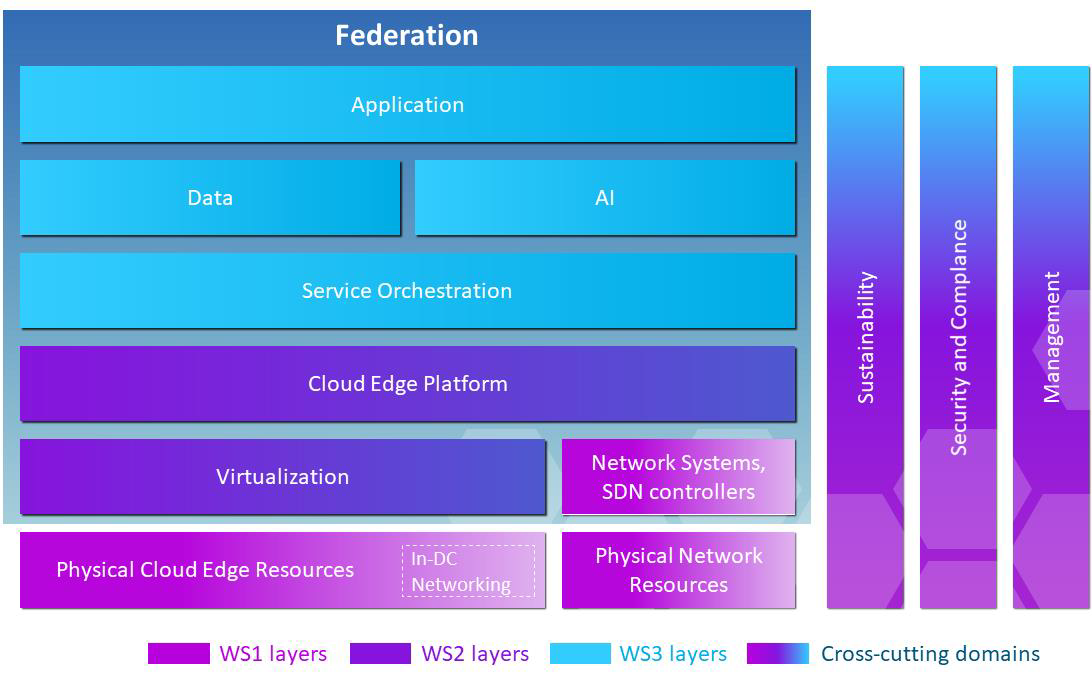 Layers and domains of the IPCEI-CIS Reference Architecture
How can the HiPEAC community get involved in this effort?
We need all hands on deck, industry and academia. Through projects like NexusForum.EU, we are trying to bridge the gap between EU-funded research projects that are exploring new technological solutions and those European industrial partners that are willing to incorporate them into new, innovative products. The HiPEAC community is a key actor in this process, and their potential to contribute to the adoption and improvement of sovereign technological solutions in Europe is huge. We will work together to make sure that there is a gradual alignment between projects at different technology readiness levels (TRLs) and help these collaborations to bring real value to the European open-source technologies that industry is adopting.
What would you say to people who feel that pursuing digital sovereignty is not worth the effort, as it is impossible to ‘catch up’ with other world regions?
I don’t think it is a question of ‘catching up’ with other regions; it is about reclaiming the right to decide what kind of digital world we want. Right now, these decisions are made for us by a handful of megalomaniac billionaires living thousands of kilometres away, with zero empathy for the millions of people who use their platforms and products. The struggle for digital sovereignty is not only about Europe having its own data centres; it is about bringing democracy into an area of our economy that has become vital for many counties and private companies, but also for individual citizens. To those people who feel overwhelmed by the challenge I would ask: yes, it is a hard task, but what’s the alternative if we don’t even try?