Following a series of unsuccessful projects to build supercomputers in the 1980s, Mateo notes, enthusiasm for European supercomputer projects cooled, with none being funded by the European Commission for some years. Yet it seemed clear that these projects had failed in part because there wasn’t a solid base in Europe to support them – a network bringing together the expertise in the relevant fields.
Although it lacked a supercomputing industry, Europe was strong in embedded systems. ‘To those of us who started HiPEAC it was clear that chips for embedded systems – which, at that time, were somewhat basic – would converge with the powerful chips needed for supercomputers in less than 20 years,’ says Mateo. Hence focusing on high-performance chips for embedded computing could help future-proof the European embedded computing industry, while at the same time building capacity to develop high-performance systems designed in Europe.
To build this capacity, Europe needed a network of excellence in software-hardware co-design, Mateo explained to policy representatives in Brussels. The core of this network, he added, should be the bridge between software and hardware – that is, computer architecture and compilation.
Taking advantage of the 1998 edition of the International Symposium on Computer Architecture (ISCA) in Barcelona, Mateo approached several colleagues ‘who immediately bought into the idea’ and they started preparing a proposal. Initial academic patrons of HiPEAC, Mateo recalls, were Olivier Temam (France), Stamatis Vassiliadis, Koen Bertels and Georgi Gaydadjiev (The Netherlands), Manolis Katevenis and Angelos Bilas (Greece), Nacho Navarro, Josep Llosa and Mateo Valero (Spain), Antonio Prete, Pierfrancesco Foglia and Roberto Giorgi (Italy), Theo Ungerer (Germany), Koen De Bosschere (Belgium), Per Stenström (Sweden) and Michael O’Boyle (UK). Industry representatives included Krisztián Flautner (Arm - UK), Erik Norden (Infineon - Germany) and Marco Cornero (STMicro - Italy), Jakob Engblom (Virtutech– Sweden) and Bilha Mendelson (IBM).
HiPEAC1 kicked off on 1 September 2004, partly thanks to the ‘unconditional support’ of project officer Mercè Griera, Mateo notes. The first project lasted four years and was coordinated by Mateo, with project management by Pilar Armas. Since 2008, HiPEAC has been coordinated by Koen De Bosschere of Ghent University in Belgium. ‘Koen has put enormous effort into coordinating subsequent editions of the HiPEAC project. Building on the original idea, he has been very successful in making the network stronger and larger in each sprint, and I am very proud of what it has become,’ says Mateo.
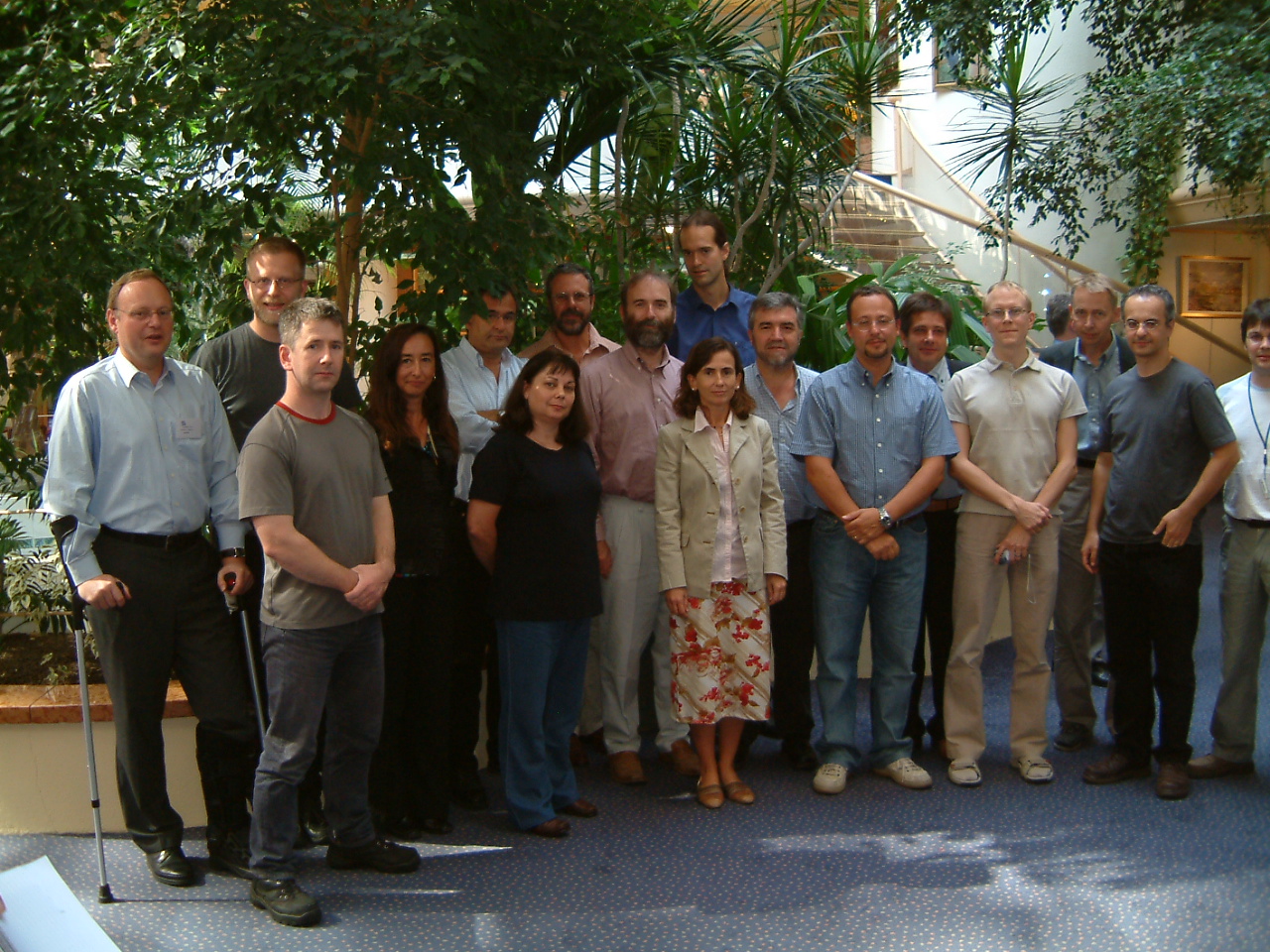 HiPEAC1 kickoff meeting in Juan-les-Pins, 30 September 2004. From left to right: Theo Ungerer, Krisztián Flautner, Michael O’Boyle, Mercè Griera i Fisa, Stamatis Vassiliadis, Bilha Mendelson, Manolis Katevenis, Koen De Bosschere, Pilar Armas, Erik Norden, Mateo Valero, Marco Cornero, Antonio Prete, Jakob Engblom, Per Stenström, Olivier Temam, Josep Llosa
A network for Europe: Collaboration, training and dissemination
The main aim of the initial HiPEAC projects was to promote collaboration between European researchers, many of whom, at that time, only crossed paths at American conferences. ‘We had funding to do joint research, which allowed us to get to know each other and strengthen our research. From these initial projects, we progressed to preparing bids for joint European projects funded by the framework programmes, with great success,’ Mateo recalls.
Education and training also formed fundamental planks of the HiPEAC network from the outset, contributing to excel-lence in European computing research, with ACACES, the long-running HiPEAC summer school, as the main training event. The HiPEAC conference was established as a key dissemination venue for members’ research; it now regularly brings together over 500 researchers in the field from all over the world in different locations around Europe. To strengthen collabora-tions, HiPEAC ran a series of Computing Systems Weeks for many years; currently, HiPEAC7 is building value networks within the European computing ecosystem, such as the Computing Continuum group of high-level European organi-zations to align priorities in European Union (EU) research. ‘These activities are not only fundamental to making us better researchers; they create a united Europe,’ says Mateo.
Indeed, the pan-European nature of the HiPEAC network, as opposed to a group of countries with competing interests, laid the groundwork for strategic high-performance computing projects. ‘The Mont-Blanc project, which sought to create supercomputers out of Arm chips, was born in HiPEAC. The European Processor Initiative and its successors have their roots in HiPEAC. The network created a proactive, collaborative research environment that was crucial to building major EU research ventures,’ Mateo says.
The evolution of architecture
Since HiPEAC’s founding in 2004, the processor landscape has changed significantly; with physical limits challenging Moore’s Law, which observed that the number of transistors in an integrated circuit doubles about every two years, engineers have turned to alternative means of increasing performance. Mateo identifies an evolution from multicore chips, to accelerators, to chiplets.‘The emergence of multicores required parallel processing within chips and augmented the importance of on-chip communication, as well as energy efficiency, and had a knock-on effect on compilers and runtime. From the earliest editions of its vision document, HiPEAC foresaw that multicores would be needed for embedded systems,’ he adds.
Later, with the waning of Moore’s Law, accelerators began gaining prominence. Of these, graphics processing units (GPUs) are currently the most successful in HPC, notes Mateo. Other examples of accelerators for high-performance appli-cations include the Intel Xeon Phi, based on a single archi-tecture devoted to short vectors, and the IBM/Sony/Toshiba Cell processor, based on heterogeneous processing on processor-specific hardware, says Mateo. ‘An additional line that we are pursuing at BSC is the long-vector approach, the central subject of our developments around the RISC-V architecture and its vector extension.’ Indeed, due to the efficiency gains of vector processors as compared to scalar processors such as GPUs, Mateo sees potential for made-in-Europe chips to compete with giants such as NVIDIA.
Chiplets – mini chips specialized for particular purposes – are the logical evolution of this trend towards heterogeneity, says Mateo, offering the potential for greater density of computing power through 3D integrations.
To further accelerate complex algorithms, the next step is quantum computing, although, in line with fellow HiPEAC members such as Yale Patt and the HiPEAC Vision, Mateo’s view is that quantum will be limited to accelerating particular regions of code that are too complex to be solved with tradi-tional computing architectures.
European HPC: From acquiring to producing
The importance of supercomputing as a tool for European scientific research was recognized by the European Commission early on, and PRACE, the Partnership for Advanced Computing in Europe, was launched as a means to provide access to top-tier machines. ‘Evolving in parallel with HiPEAC, PRACE allows scientists to access the most suitable machine for their needs,’ notes Mateo.In 2017, the EuroHPC JU was launched with twin objectives: to support a pan-European supercomputing infrastructure of top-tier machines while, at the same time, generating a competitive innovation ecosystem in supercomputing technologies, applications and skills. ‘PRACE began with a plan to install between three and five tier-0 supercomputers. Currently, in Europe, we have eight tier-0 machines. Not only that, but the variety of design approaches used for these supercomputers is testament to the heterogeneity that has become dominant over the years since HiPEAC was founded,’ says Mateo.
Prior to the launch of EuroHPC, Mateo and other HiPEAC founders had been calling for an ‘Airbus of HPC’ that could deliver a European exascale machine, developed with European processors. In 2018, the European Processor Initiative was launched with the aim of developing a designed-in-Europe Arm-based central processing unit (CPU) and RISC-V-based accelerators. A major international follow-up project, DARE, is due to start in 2025 to continue this work, and MareNostrum 6, the next version of BSC’s supercomputer, is to be a demon-stration of the technologies developed in this effort. ‘HiPEAC and PRACE have been growing along with the software and computing infrastructure in Europe. Now we can focus on the development of chip technology, and the commercialization of research concepts developed by HiPEAC members,’ says Mateo. ‘The next 10 years will be a period of building a self-sufficient European chip manufacturing and processor-design ecosystem.’
In pursuit of this goal, EU Member States will have to join forces to achieve what they would be unable to do individually. ‘The Draghi report on European competitiveness highlighted that most individual member states cannot achieve the scale to deliver world-leading research and technological infrastruc-tures, which is why coordinated initiatives such as EuroHPC and institutions like CERN are essential,’ says Mateo.
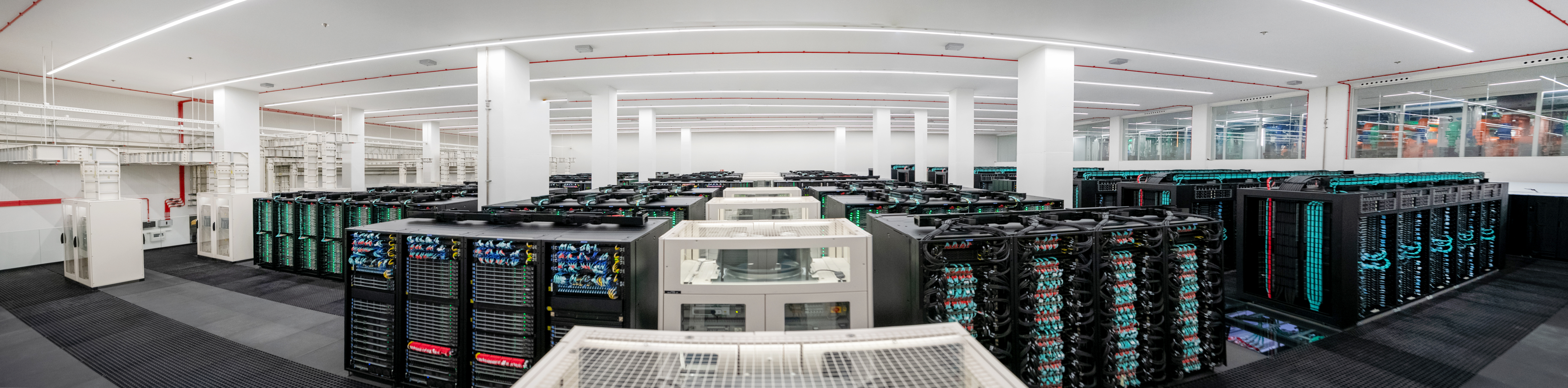 MareNostrum 6, one of the most powerful supercomputers in Europe
When HPC met AI
The development of supercomputing technologies in the future, though, will be accompanied by the dominant computing trend of recent years: artificial intelligence (AI). ‘Over the last few years, artificial intelligence has been a natural companion of HPC,’ says Mateo. ‘The data-processing capabilities and compute power of HPC has enabled AI to grow, and AI is now returning the favour in spades: it is changing the way we do research with supercomputers.’ In terms of industrial competi-tiveness, Mateo highlights AI Factories, a new subprogramme within EuroHPC which aims to facilitate access to AI provided by HPC facilities to improve the productivity of small and medium enterprises (SMEs), the backbone of the European economy. ‘In the future, EuroHPC supercomputing facilities will also be made available for AI startups, which will be crucial in propelling Europe to be a leader in HPC-AI convergence,’ Mateo adds.Just as Europe needed to fund HPC development, so it must support the development of AI, according to Mateo. ‘Leaving the development of AI to the United States or China would be a major error,’ he warns. ‘We cannot limit ourselves to regulation; to do so would be to accept a role as the referee of a match that we’re not playing ourselves. We need to develop chips for AI and, in parallel, develop algorithms to exploit them in an energy-efficient way, through co-design – something which is in HiPEAC’s DNA,’ he adds. ‘HiPEAC offers a model for European politicians and companies of how to unite behind a common objective. In Europe, when we work together, we can achieve anything.’