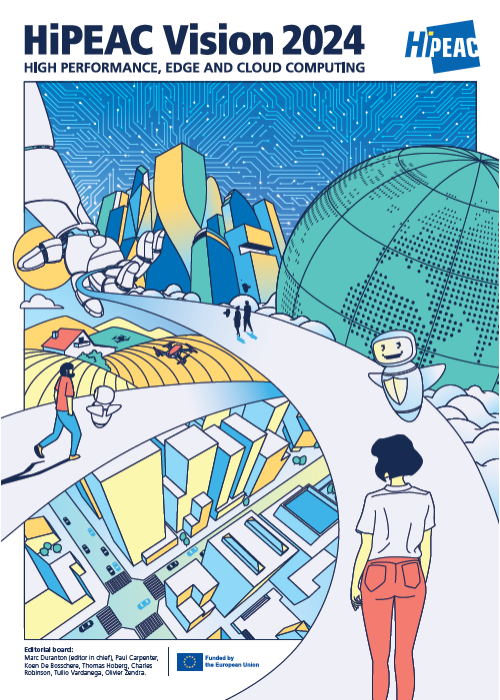
Given the dizzying pace of technological change – particularly in artificial intelligence (AI) – the European computing ecosystem must react swiftly to take its place within the competition, proposing attractive and efficient solutions. The way forward for Europe, as set out in the HiPEAC Vision 2024, is the ‘next computing paradigm’ (NCP), a convergence of key technologies from the web, cyber-physical systems (CPS), the cloud, the internet of things (IoT), digital twins, and AI into a coherent, federated ecosystem that conforms to ‘European’ ethics.
‘The web is only 35 years old, and yet it has changed the world profoundly, essentially becoming indispensable in our daily lives – and AI seems to be even more disruptive,’ says Marc Duranton (CEA), the HiPEAC Vision editor-in-chief. ‘Europe has to find its place in this quickly evolving world, and we believe that what we call the ‘next computing paradigm’ (NCP)– seamlessly executing services located where they are most efficient, from edge to cloud, orchestrated by trusted assistants, powered by innovative hardware and taking this approach into the physical world – is the way to achieve this.’
‘A holistic approach is needed to create future computing systems that genuinely meet social needs while keeping people safe and respecting planetary boundaries,’ adds Professor Koen De Bosschere (Ghent University), the coordinator of HiPEAC. ‘Europe has an opportunity to differentiate its NCP solutions through a commitment to quality, adopting a clearsighted approach to AI, implementing robust security protections, and conducting full lifecycle assessments for sustainability.’
In a departure from previous editions, this release of the HiPEAC Vision comprises a short summary document with the main recommendations and a longer companion volume (the ‘rationale’) of articles authored by experts in different fields. Building on the conclusions of the HiPEAC Vision 2023, six high-level recommendations have been identified, as follows:
1, Promote the ‘next computing paradigm’ and develop the technologies that will make it happen.
The next computing paradigm entails an integration of the web, cyber-physical systems, cloud, IoT, digital twins, and AI into a coherent, federated ecosystem that intertwines the computing realm with the physical world. It emphasizes spatial computing, (generative) AI at the edge, dynamic web integrations, user-centric models and intelligent, efficient and trustable orchestration of distributed services.2. Make the European Union a strong player in artificial intelligence, particularly for widespread use at the edge.
The focus on AI highlights the integration of generative AI in embedded devices, the capabilities of various processors to run these models, the role of generative AI in helping the development of software and hardware, and their societal and technological impact.3. Develop innovative and efficient new hardware solutions, from architecture to technology.
Recommendations for new hardware development include proactive architecture development, fast chip / system prototyping, a global value-chain perspective, developing the chiplet / interposer ecosystem, and a focus on sustainability and sovereignty in hardware development.4. Make cybersecurity a major upfront concern in every computing system.
The cybersecurity recommendations deal with the challenges associated with the NCP and offer directions for solutions, both in hardware and software, including the development of security tools, of vulnerability identification and mitigation, of open-source and EU-made resources that can be audited, the automation of cyber-defence tools, and the enhancement of user authentication and privacy control. They also highlight the impact of LLMs, which can be used to detect and protect against malicious attacks, but can also be used to engineer such attacks.5. Make sustainability lifecycle assessment a requirement for all new computing systems.
Sustainability recommendations include designing lifecycle models for information and communication technology (ICT) devices and services, developing a sustainability-focused design methodology, new business models considering the full lifecycle, and developing effective ‘ICT for green’ applications.6. In all domains, foster global thinking, develop methods and tools relating to complex heterogeneous integrations and promote cross-domain / cross-topic collaborations.
The global recommendations focus on promoting collaboration across various technological domains, launching cross-domain project calls, and establishing competence centres. Emphasis is also placed on leveraging open-source hardware and software, and developing tools to address multi-dimensional challenges. Work should continue to bridge and ‘break silos’ in order to improve EU capacity to create and develop innovations in the computing (continuum) domain.Given the cross-cutting importance of sovereignty, and the major geopolitical implications of control over key computing infrastructure, this topic is now woven throughout the document.
This edition once again features cartoons by the Belgian comic artist Arnulf, which provide a satirical take on the content.
- The HiPEAC Vision 2024 may be downloaded from the HiPEAC website: hipeac.net/vision
- Articles forming the ‘rationale’ may be downloaded from hipeac.net/vision. Printed copies are available on request.
- A short video summarizing the main message is available on HiPEAC TV: bit.ly/HiPEAC_Vision_2024_video