How did you end up specializing in your field?
I started studying engineering because I loved math. In my first year at the university, during a course on numerical techniques where we had to program optimization problems, I realized that I loved programming and I found it fascinating that I could experiment at home behind a computer. Over time, I realized that I was most interested in how computer systems work, how to design them and how to program them. During my PhD I became particularly interested in performance modelling and workload characterization. Later, I also got interested in microarchitecture and computer-system resource management. My latest focus in on sustainability.
What prompted you to start researching sustainability? Why should it be on the HiPEAC community’s radar?
I’ve always loved nature. Watching how humanity is exhausting the planet, and witnessing young people protesting for climate change, I started wondering how big the impact of information and communication technology (ICT) on the environment was. I proposed to my department that we should start a new course on sustainable computing, and they approved. It was while I was working on the course material that I became really interested in the topic. At the time, two to three years ago, there was no course material available elsewhere, and so I had to compose my lecture material myself. I did a lot of research trying to make sense of the limited, disparate data that is available.
I believe the HiPEAC community should indeed focus on sustainability. ICT today is responsible for 2-4% of greenhouse gas emissions. This is on par with the aviation industry, and it is growing. Some projections state that by 2030, ICT will be responsible for 7-20% of all electricity demand. We should do something. I would even state that it’s our moral duty to act! And I believe there is lots we can do, as hardware designers, system integrators, and software developers.
What, for you, are the main issues concerning sustainability?
It turns out that when looking at the total environmental footprint of a computing device, the embodied emissions – the emissions for manufacturing, assembly, transportation, and end-of-life processing – are dominant compared to the operational emissions during a device’s lifetime. This is the case for personal mobile devices such as smartwatches, smartphones, tables, laptops as well as for servers in hyperscale data centres. Operational emissions seem to dominate for always-connected devices.
My own analyses indicate that embodied emissions will soon dominate for nearly all computing devices. The reason is twofold. On the one hand, devices are becoming increasingly energy efficient, so this reduces the operational footprint. On the other hand, the demand for computer chips continues to increase – by around 9% per year – and, in addition, semiconductor manufacturing is becoming increasingly energy demanding – an increase of around 11% per year. Hence we can expect that the embodied footprint will continue to increase.
As computer engineers and scientists, we therefore need to start designing computer systems with sustainability and especially the embodied footprint as a primary design goal. We need to start designing smaller chips to reduce the embodied carbon footprint. To pick one example: dark silicon – or providing tens of accelerators on chip that are powered on only when needed – is considered the way forward to continue scaling performance as progress in chip technology is slowing down, but it is harmful for sustainability. The reduction in operational footprint is unlikely to outweigh the embodied footprint that these accelerators incur. Sustainability requires us all as a community to start thinking differently about how to design computer systems. We need to design computer systems more holistically considering the overall environmental footprint.
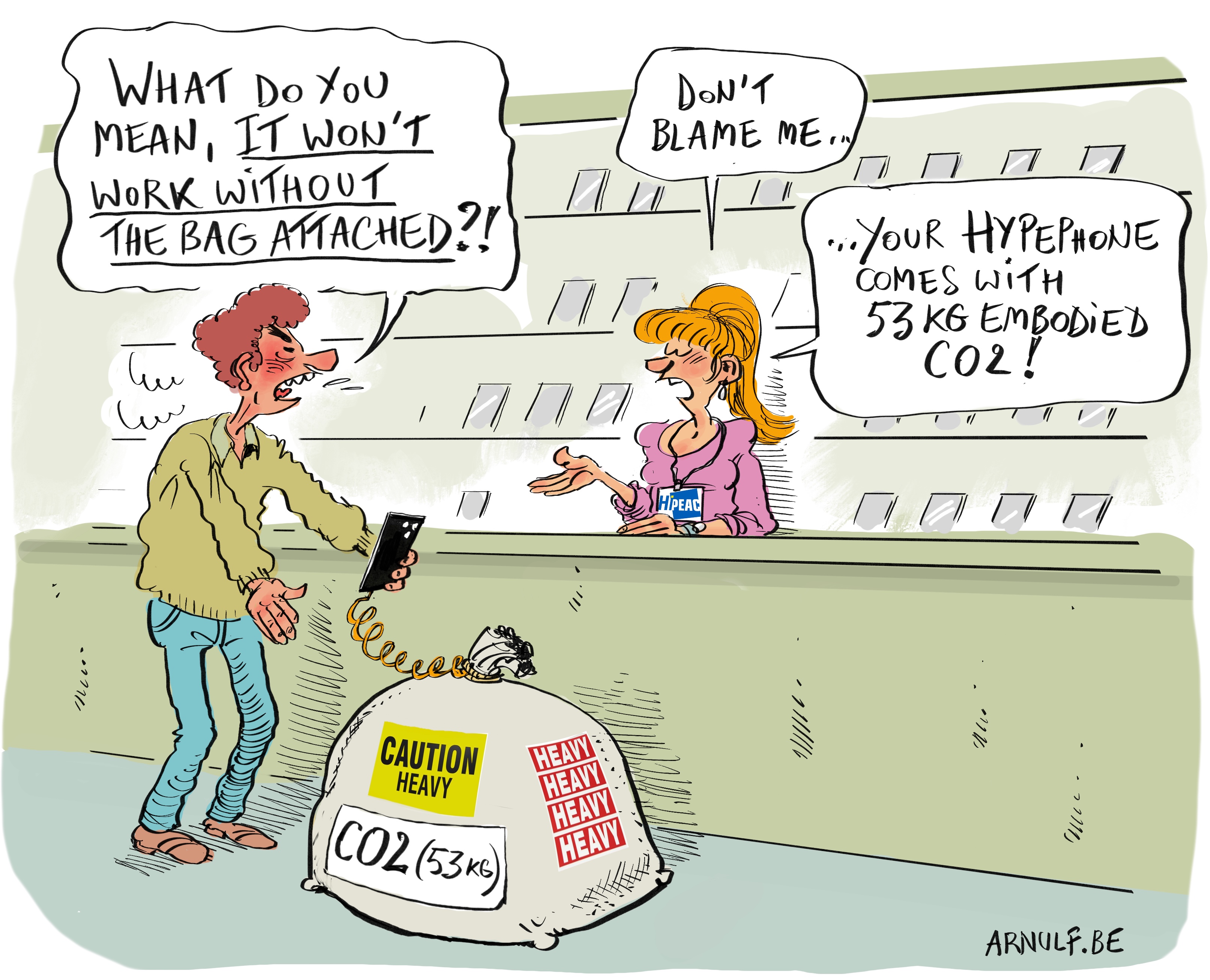
Cartoon credit: Arnout Fierens, HiPEAC Vision 2024
What are the main challenges in researching and teaching this topic?
A major challenge is that there is little data available pertaining to sustainability, and when data is available, there is quite a bit of uncertainty about the data. Companies are starting to publish lifecycle assessment reports about the products they bring to market, and these reports also acknowledge that some numbers are based on industry averages or estimates.
My take on it is that we should embrace the uncertainty and go back to first principles using proxies for the embodied and operational footprint. We can use chip area as a proxy for the embodied footprint and energy / power as a proxy for the operational footprint. Reasoning about chip area and energy / power and performance in a holistic manner enables computer engineers and scientists to make reasonable design decisions despite the uncertainty. So, while we should continue to aim for high-quality data and better understand the environmental footprint of computing, there is no time to waste, and I believe we can make a difference today.
Teaching sustainability topics is challenging but very rewarding and interesting. Sustainability is a fundamentally multidimensional problem, and there are so many stakeholders. Sustainability is also a much broader problem than global warming and carbon emissions: it covers raw material extraction, end-of-life repurposing or recycling, water consumption, business models, legislation, etc. This oftentimes leads to very interesting discussions in class where we analyse the pros and cons of sustainable developments.
For example, while we as engineers and scientists can try to design computing devices with a lower carbon footprint and less material use, there is always the risk of a rebound effect, also called Jevons’ paradox. It is well known that making devices more efficient oftentimes leads to increased usage and deployment. Given our linear economy, which is based on selling stuff, I believe that we need new business models towards a circular economy. Also, we need regulation and legislation to temper the demand for new devices and the increase in the environmental footprint of ICT.
What are your career highlights and future plans?
My whole career has been a highlight in my view. It was great to grow as a researcher during my PhD and postdoc period, and later as a professor. Mentoring students, seeing how they learn new stuff in class, seeing how they grow as researchers is all very rewarding. I always enjoy working on a new project with collaborators and students. In the beginning there are lots of unknowns and you don’t really understand what the problem is and how to tackle it. But over time you start understanding what’s going on, and the most wonderful moment is when all pieces of the puzzle come together.
Of course, it’s also very rewarding to be able to publish your research in the field’s top-tier conferences and then also receive international recognition through awards – I’ve been lucky enough to receive a few. As for the foreseeable future, I’m planning to focus my research on making our computer systems more sustainable.