
Why should we take sustainability into account when designing computing systems?
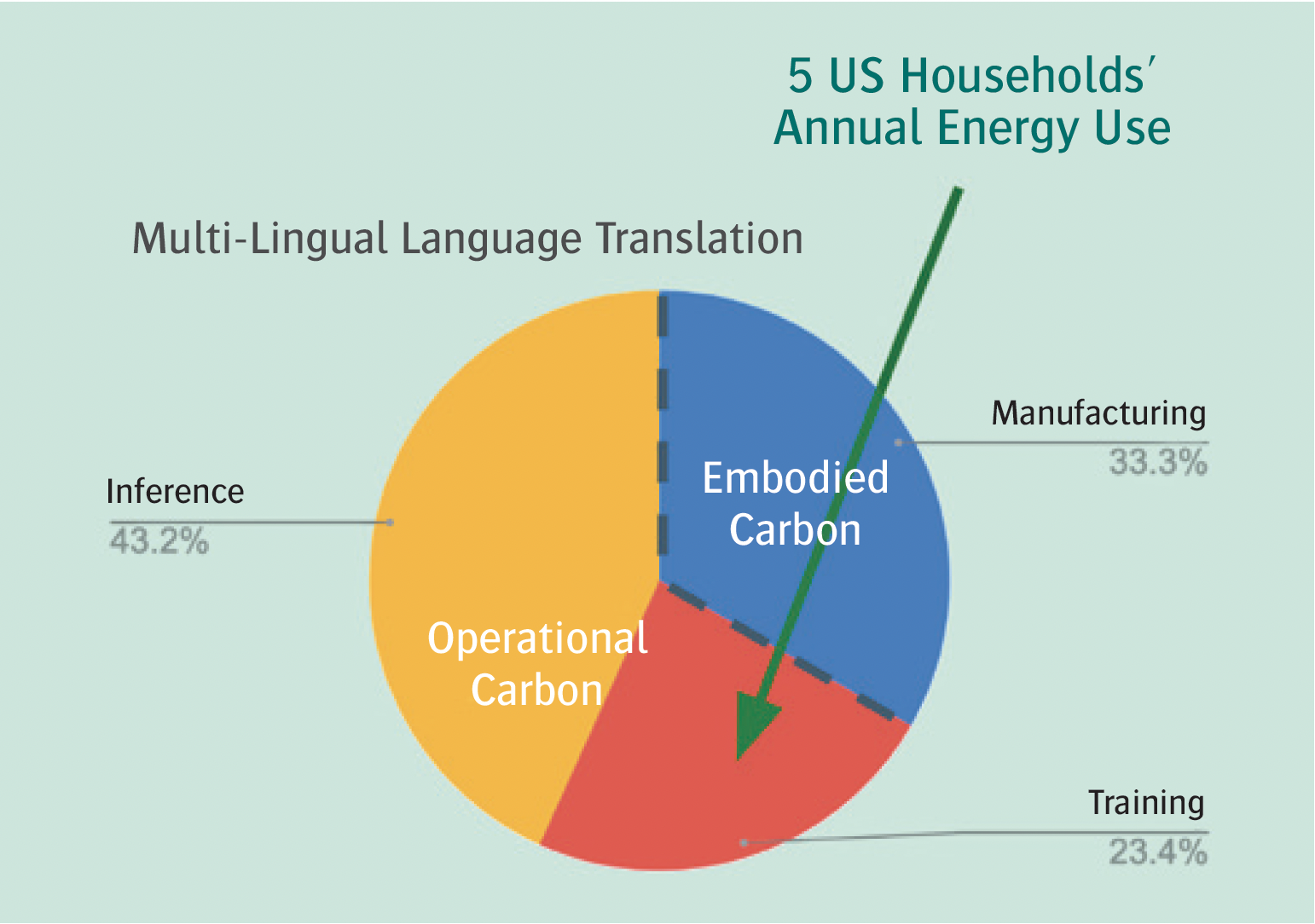
As digital technologies become an essential part of humanity, their growing prominence is reflected in computing’s energy footprint. Between 2017 and 2021, the electricity consumption of Google, Meta, and Microsoft grew by more than 2-3 times. Artificial intelligence (AI) is an important application driver: training an industry-scale multilingual language translation model to state-of-the-art prediction accuracy in 2021 has been estimated to produce 45.2 tonnes of carbon emissions. This is equivalent to the annual energy use of 5.4 US homes for each training run. In reality, AI workflows typically involve dozens, if not hundreds, of training runs to produce a final model. Serving translation inference at scale with the language translation model can triple the training carbon footprint of the final model over its life cycle.
However, AI’s carbon footprint goes beyond operational energy use. AI systems used for model training and inference at scale come with manufacturing carbon emissions that are produced during the production of system hardware. Manufacturing carbon emissions contribute a substantial portion to AI’s overall carbon footprint. Taking the multilingual language translation task as an example, the overall carbon footprint is approximately four times the carbon footprint of model training, resulting in ~180 tonnes of carbon emissions or ~22 US homes of annual energy use. Algorithmic and system optimization can effectively improve energy efficiency for the multilingual language model by more than 800 times (Wu et al., 2022). Data centres operated by Meta are supported by 100% renewable energy but efficiency is crucial as we develop new and more advanced AI systems. To sustain the explosive demand of AI, we must understand the environmental implications of AI technologies and drive technology development in an environmentally accountable manner.
Why is it important to be able to accurately measure the carbon footprint of computing systems, and to consider the full lifecycle of the system?
We cannot reduce what cannot be measured – to minimize computing’s carbon footprint, the first step is to be able to quantify the lifecycle emissions of a computer system. However, it is challenging to do so today: characterizing and analysing carbon emissions is a complex process, as compared to performance measurement, power and energy modelling. There aren’t standard metrics or publicly available tools that standardize carbon footprint measurement of computers, not to mention the environmental footprint of computing from the holistic standpoint.
What should computer engineers have in mind when designing new systems?
The carbon bottleneck of computer systems is shifting from operational to manufacturing carbon. This is particularly prominent for consumer electronics (U. Gupta et al, 2021). Taking iPhone3 from 2009 and iPhone11 released a decade later as an example, iPhones are seeing a reduction of approximately 1.6x in their operational carbon footprint, while the manufacturing carbon footprint has tripled due to more advanced hardware architectures and a higher semiconductor manufacturing environmental footprint. Roughly 82% of the iPhone11’s carbon footprint is embedded in the hardware while 18% comes from operational uses.
This shift opens up a new problem space for computer system designers. To architect environmentally sustainable computer systems, we must find novel ways to reduce manufacturing (and the overall lifecycle) carbon while meeting the performance requirements of applications and, at the same time, minimizing power and chip area. An important first step is to develop carbon models to assess and enable agile hardware design by putting carbon as the first optimization principle. Using the carbon footprint of different process technologies, including compute logic, memory, and storage, system architects will be able to minimize the overall carbon footprint of a computer system at design time. There are a few recent works towards this direction; see for example Eeckhout, 2023 and Gupta et al., 2022.
There are also new optimization opportunities on the horizon for carbon-aware data-centre computing. Taking into account renewable energy variation, energy storage, and computation scheduling, the carbon-aware data-centre design space presents new design and management decisions as data-centre operators put total carbon as the optimization objective (see for example Acun et al., 2023). To enable and accelerate environmentally sustainable computing, the carbon-aware design frameworks – ACT and Carbon Explorer – have been open sourced and are available on GitHub.
What changes would you like to see in the way computing systems are developed?
Based on the real-world carbon footprint characterization results for computing at scale, I would like to challenge our computing industry to think deeply about the implications of the carbon bottleneck. What new opportunities are emerging across the system stack, from programming languages and runtime management to system architecture and hardware design? How do we put carbon as the first design principle effectively? What is an effective interface between the power grid and data-centre operators (and other significant energy consumers on the grid) to realize a sustainable, reliable, and cost-effective future for computing?
I would love to see carbon being a standard metric that all technological solutions and products come with, so that any research paper comes with a climate impact statement and any computing equipment discloses how green it is.