Why get involved
The HiPEAC Student Challenge is an opportunity to test your programming and/or computer architecture skills, tackle real-life problems, learn-by-doing research methodologies, and connect with peers.
The challenge is open for teams of up to 5 members. Participation is simple. Start by registering your interest by 10 September – see ‘Important dates’, below.
Participating students based in Europe will be able to attend the 2026 HiPEAC conference (26-28 January 2026, Kraków) for free and are also entitled to funding to cover their travel and accommodation costs (up to €1,000 per team).
How to participate
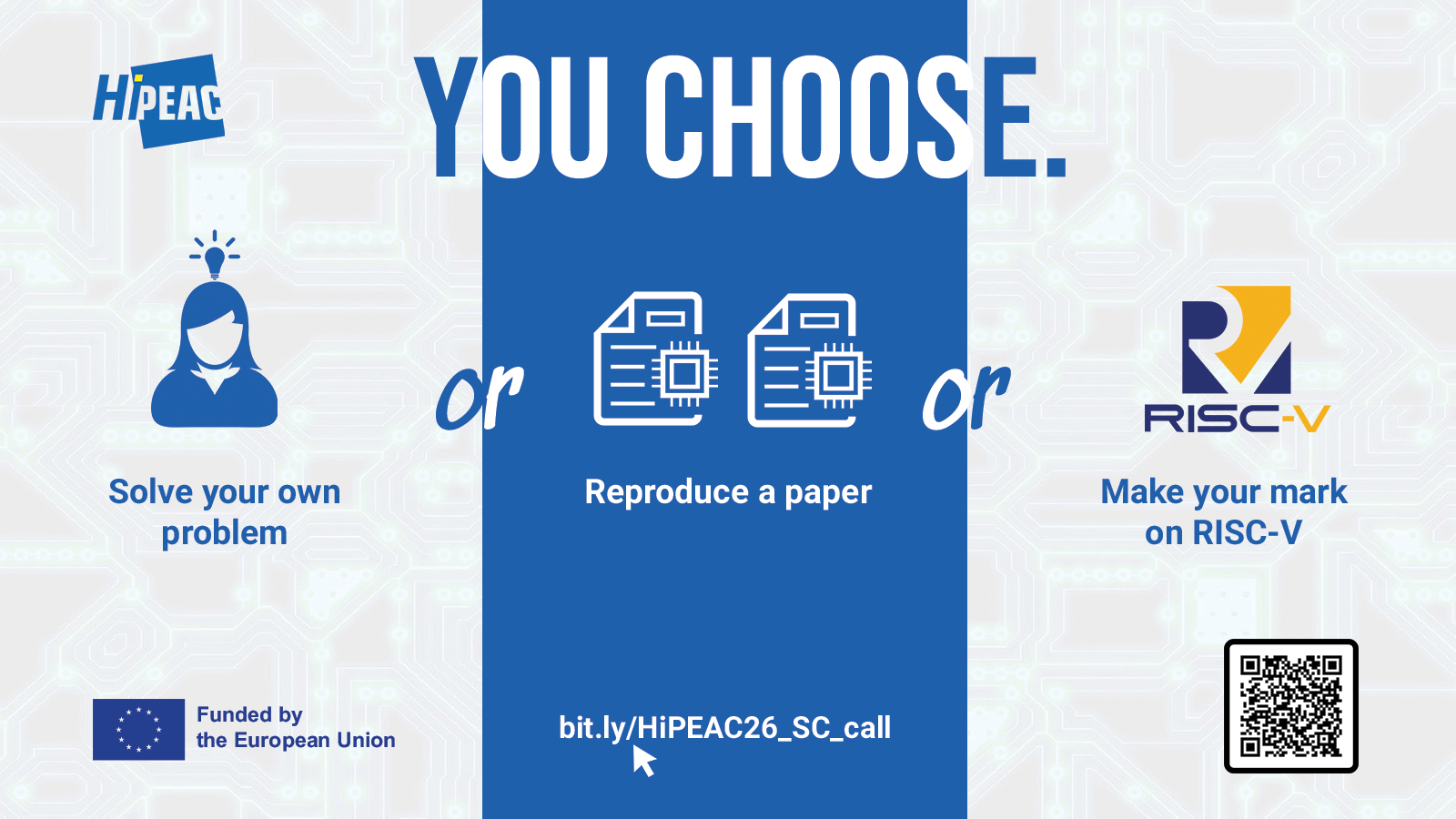
There are three different ways to take part in this challenge:
Option A: Make a difference in your local area
Present a project that improves a situation (transportation, work, study, environmental, etc.), facilitates a task (search, movement of material, storage, ordering, organization, etc.), or addresses another scenario where something could be improved. The use of AI in the solution is particularly encouraged. Examples include:
- An internet-based solution to promote socializing by older people.
- Making agricultural irrigation systems more water efficient.
- System alarms to share information among local residents.
- Increasing the speed of updating data over the network.
- Energy saving in backups performed in large companies (such as banks).
Once you’ve settled on a problem, your team will work on a specific solution to the problem. This could be:
- developing a new solution, if existing solutions aren’t suitable from your point of view; or
- basing your solution on an existing one and trying to improve it, update it, identify a cool app for users…
You will need to explain how the data involved is managed, including whether a large amount of data is required at a given time or for a specific period, whether the data will be distributed across different locations, whether the data is in various formats, and so on. There’s no need to deliver a complete implementation. However, you will need to set out the goals you aim to achieve, along with a framework with the main parts which need to be implemented (it would be good to have a chosen model, tool, framework, platform, maybe a specific architecture, or anything else you clearly envision in your ‘product’).
Option B: Reproduce scientific research
Choose a published scientific paper from this list and try to reproduce the code on a different platform.
Select a paper (with code) accepted for the HiPEAC conference, either the 2025 edition or previous years – the organizers can help you select a suitable paper in line with your interests. Work to build/run and produce the results of the paper, either using your local computing resources or remote resources if needed.
Optional: Improve or optimize the proposed solution in the paper.
Option C: Make your mark on RISC-V
You might have heard of RISC-V, the open instruction set architecture. This challenge is your chance to contribute to the RISC-V community, either on software or hardware. Just select a RISC-V-compatible open-source tool and contribute to the project by adding a new feature, optimizing the execution of a small piece of code by using extensions, compiling a new code and making it run on RISC-V, for example.
Again, for this option we encourage you to consider an AI-related challenge. As you might know, improving the performance of AI applications is complex due to the data dependencies, sparsity, and the amount of energy they demand. However, there are different ways to address these issues:
- In software: analysing the code and understanding the bottlenecks to restructure the code, using/developing/improving libraries, workflows, runtimes, extending the compiler features…
- In hardware: specializing the computing system (core, processing element, etc) by supporting a new set of custom instructions, vectorization, using different data types, etc.
Once you select your area of work (software, hardware, or both) you can work on a specific solution, for example:
- Porting a code to RISC-V and executing it on a RISC-V-compatible simulator (e.g. QEMU).
- Optimizing the execution of a code, taking advantage of RISC-V extensions (e.g. custom extensions, vector extensions…). To do this, you could use either QEMU with its RAVE plugin, or GEM5 with RISC-V support.
- Selecting an open-source RISC-V based tool (e.g. webRISC-V, RISC-V Venus, etc.) and contributing to the project by finding a bug, adding a feature, etc.
Don’t miss out – apply for the Student Challenge today!
Important dates
- 10 September: Email the organizers to register your interest in attending. Make sure you include the following information:
- HiPEAC Student Challenge 2026 as the subject line
- the challenge you will tackle: Option A, Option B or Option C
- the names of your team members (note: only students can be team members)
- your institution's name
- the name of your advisor
- 30 November: Send your title and report (4-6 pages, in the form of an IEEE-style paper), explaining your goals, methodology, how you overcame obstacles and why you think your solution works (or works better than others). Based on these reports, we will select the five best-performing teams to present their work.
- 27 January: Prepare a presentation of your work and present it at the Student Challenge at the HiPEAC conference. You are also welcome to bring a poster so that attendees can visualize your work better.
Questions? Ask the organizers:
Isil Oz (İzmir Institute of Technology, Turkey)
[email protected]
Raffaella Folgieri (University of Milan)
[email protected]
Marisa Gil (UPC/BSC, Spain)
[email protected]
Teresa Cervero (BSC, Spain) [email protected]
Georgios Goumas (ICCS/NTUA, Greece)
[email protected]
Chris Fensch (Arm Norway)
[email protected]