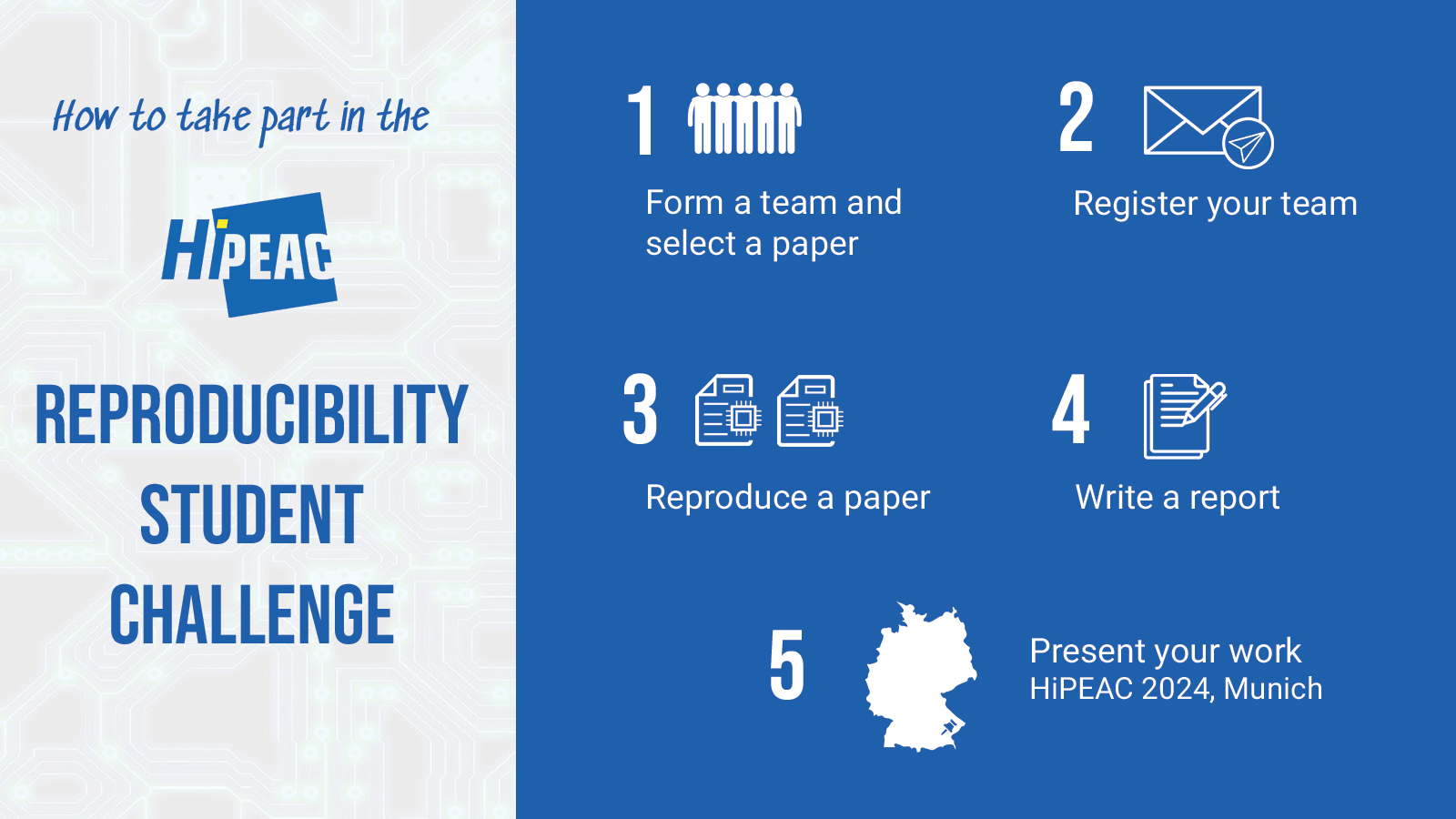
These are the next steps for anyone wishing to take part:
Select a paper
Take a look at the papers (and the associated code) accepted for the HiPEAC conference (TACO papers published in 2023), listed here. Choose three papers that you are interested in and willing to work with. You can also specify on which platform you are planning to work for reproduction, using either your local or remote resources. The organizers can help you access remote computing platforms.Email the organizers (see emails below) indicating the name of your preferred three papers.
If you haven’t done so already, indicate the full name of each team participant, their university, their level of studies (undergraduate, master’s or PhD) and the name of their mentor. Registration deadline: 10 October 2023Reproduce a scientific paper
After getting confirmation from the organizers (a few days after your registration) about the paper you can work on, start to work to build/run and produce the results of the paper, either using your local computing resources or remote resources if needed. Optional: Participants can improve upon or optimize the proposed solution in the paper.Write and submit a report
Produce a report about the work done (in the form of a scientific-style paper) and email the organizers. Based on the reports’ content (introduction, goals, methodology, conclusions, references) and presentation quality (figures, English writing, clarity of ideas), the organizers will select the four best performing teams to present their work. Performing optimization (after reproducing) is a plus.
Report submission deadline: 10 December 2023
Notification of acceptance: 20 December 2023Present the work done
Prepare a presentation of your work and present it at the Reproducibility Student Challenge on Thursday, 18 January 2024 at the HiPEAC conference.
Organizers
Raffaella Folgieri (University of Milan) ([email protected])
Grigori Fursin (cTuning Foundation) ([email protected])
Marisa Gil (UPC/BSC, Spain) ([email protected])
Isil Oz (İzmir Institute of Technology, Turkey) ([email protected])