
So Elli, what can you tell us about the compute continuum?
Well, I’m from a telecommunications background, so the first time I heard of the concept of the compute continuum was when I began working with the computation community.
Ah… so it’s like learning a whole new vocabulary.
Yes: in telecommunications, you have multi-access edge computing, where users are connected to a base station and the traffic goes to the edge. In computation, what I understand by the compute continuum is the use of different resources, from data centres to edge devices, according to the needs of the application. This means that data is processed where it makes most sense; in many cases, there is no need to send data to the cloud, as it can be processed locally, reducing latency and energy costs.
Well, that sounds pretty simple.
Not really. Some of the main issues are around interoperability and orchestration. Developing an application that can be distributed and executed seamlessly across the compute continuum is not trivial. That involves looking for the right programming frameworks and application programming interfaces (APIs), and then handling the orchestration of the computing tasks to meet the application requirements. For example, at BSC we’ve been using our in-house COMPSs programming environment for the distribution aspect.
Oh, I see. But you’ve already done a lot of work here, right?
Our research group, headed by [HiPEAC member] Eduardo Quiñones, has experience in researching and developing software frameworks that address these issues. We’re starting a new project funded by the European Union (EU) in January 2023, called EXTRACT, which will tackle interoperability between edge and cloud – bear in mind that even the same tool, such as Kubernetes, has different implementations depending on where its executed. In the EU-funded CLASS and ELASTIC projects, we worked on frameworks for smart-city mobility solutions – for connected cars and connected trams respectively – and the national projects PROXIMITY and AIR URBAN build upon this approach.
I’m glad you mentioned smart cities, as this seems an area where distributed resources would be a big plus…
Being able to distribute computations across the continuum opens up huge possibilities for meaningful applications with real social value. The main thing is to be able to extract value from data. In the case of smart cities, you have sensors collecting massive amounts of local data which could be transformed into meaningful information: sensors measuring air quality, cameras, parking monitoring systems, etc. In addition, there’s data from cellphone users, as well as macroscopic information such as bus timetables and weather forecasts. Not to mention that there will be increasing amounts of data from connected vehicles in the future.
If we could collect all this data and process it in an intelligent way, we could deliver services to enhance safety, manage traffic or adapt to specific events, such as how a major congress in the city might impact upon congestion. You could also provide personalized services, as we’ll be doing with one EXTRACT use case, which focuses on providing personalized evacuation plans for mobility-impaired people. On the collective scale, this kind of intelligence could help local authorities understand the impact of the actions they take. For example, if traffic calming measures result in safer streets and better air quality or if they have unintended consequences, such as causing traffic jams elsewhere that worsen air quality.
It sounds like edge processing has a major role here.
Yes, but most applications are currently cloud based, which is why research projects like ours are investigating how best to move computations to the edge. As an example of some of the issues we’ve encountered, in CLASS we used the LTE (long-term evolution) communications standard, but data had to go through the telecommunications operator core network before coming back to the edge. Also, the synchronization of multiple sensing sources was a challenge.
Learning from this experience helped us in ELASTIC, where we wanted to complement data from trams with, for example, data from external cameras which might spot things not ‘seen’ by the tram. However, in ELASTIC we used a WiFi connection, which had reliability issues and was not suitable for establishing fast connections with moving vehicles. This is obviously unacceptable in safety-critical, real-time systems. That’s why in PROXIMITY we will be trying integration with the 5G network.
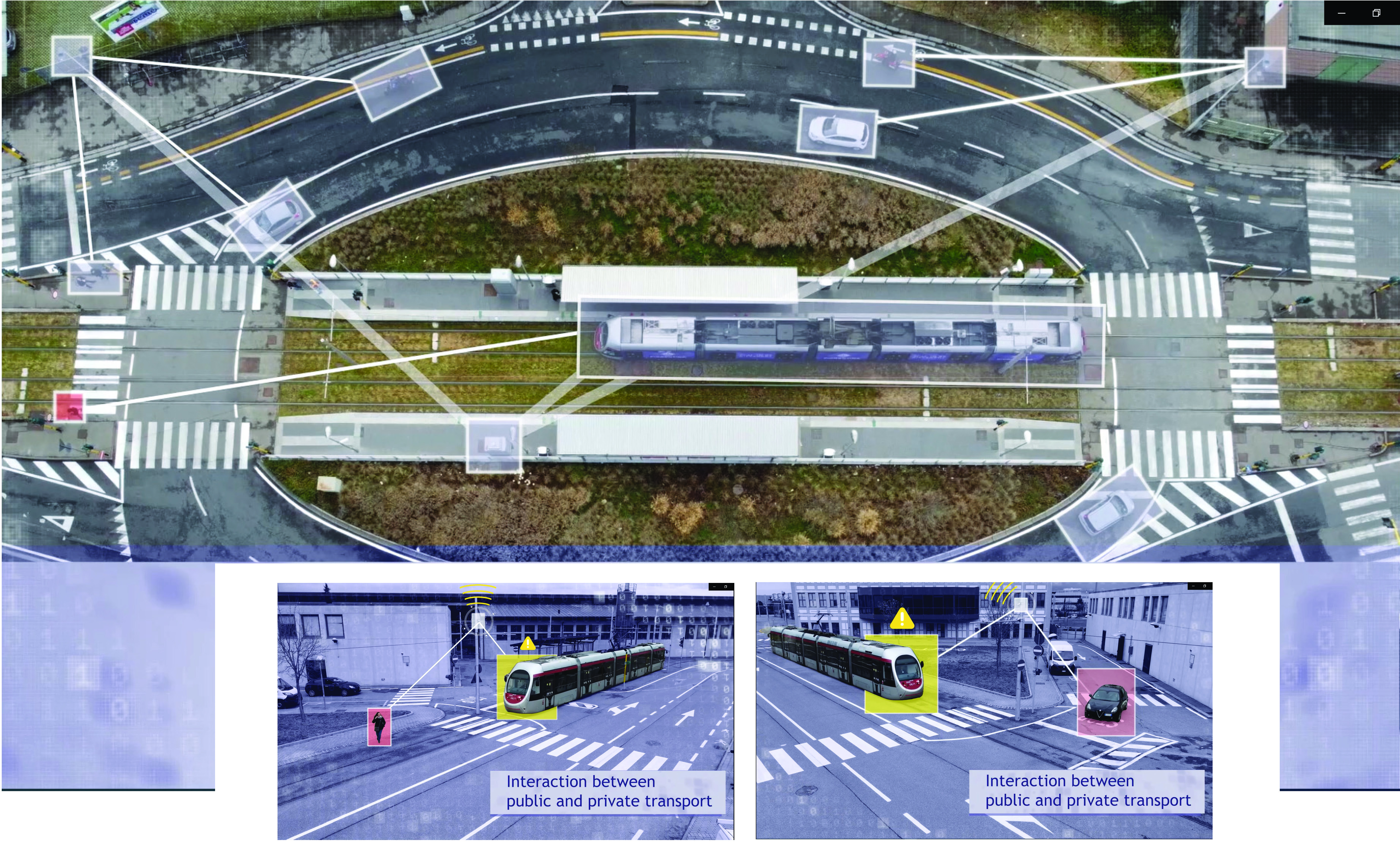 The EU-funded ELASTIC project provided a data-analytics framework for connected trams in Florence
Tell us more about PROXIMITY and AIR-URBAN.
PROXIMITY applies the same principles as ELASTIC but in a local setting, in this case the city of Barcelona. It will provide a software framework for the development, deployment and execution of data-analytics applications. We’ll use programming models to distribute the computing and APIs to connect to the 5G network. We’ll also create a converged platform that integrates edge and cloud resources and provide dynamic orchestration – with joint compute and communication resource allocation – to meet application demands. This framework will be used to identify accident blackspots and generate alerts – for example, providing visual reminders to motorists and tram drivers.
AIR-URBAN will leverage a similar architecture, but in this case we will investigate the impact of traffic on air quality and emissions. Today, there are many models estimating vehicle emissions, but these are based on simulations. Our goal in this project is to analyse real-time traffic data using artificial intelligence (AI) and detect how specific traffic events impact air quality at small time scales, as well as improve current models for air quality prediction. This will be set up in Barcelona, and the information will be used to help evaluate the impact of measures introduced by the city council.
So many things, and we still haven’t discussed privacy or security…
Yes, that’s a massive area of research. We took steps towards secure edge applications in ELASTIC, and security will also feature in EXTRACT. But we are open to collaborations with colleagues who specialize in this area.
PROXIMITY is funded under the Spanish Government’s Proyectos de Generación de Conocimiento 2021 scheme (PID2021-124122OA-I100) while AIR-URBAN is funded under the Proyectos de Transición Ecológica y Transición Digital 2021 call (TED2021-130210A-I00). CLASS and ELASTIC received funding from the European Union’s Horizon 2020 research and innovation programme under the grant agreement numbers 780622 and 825473 respectively, while EXTRACT is funded under the EU’s Horizon Europe research and innovation programme (grant agreement number: 101093110).