HiPEAC Student Challenge IX: IoT for everyone
Can you solve a problem affecting you or the people that matter to you with an IoT solution?
In this HiPEAC Student Challenge, we’re looking for teams of computer science students – whether undergraduate, master’s level, or PhD – to think of a problem, then come up with an IoT-based digital solution. This could be:
- improving a situation (transportation, work, study, environmental, etc.)
- facilitating a task (search, movement of material, storage, ordering, organization, etc.)
- or any other scenario where something could be improved.
It should relate to an area you’re well-acquainted with, such as your house, neighborhood, university, or city, and to people you know, such as your family, friends, or classmates.
Some ideas from the previous challenges:
- Machine learning-based solution for people with dysarthria
- AI-based remote communication exploiting tactile sign language for deafblind people
- System alarms to share information among neighbours
- Open-source IoT-based sustainable agriculture
- Bluetooth-based mobile application to help find missing people
- Public transport seat occupancy detection
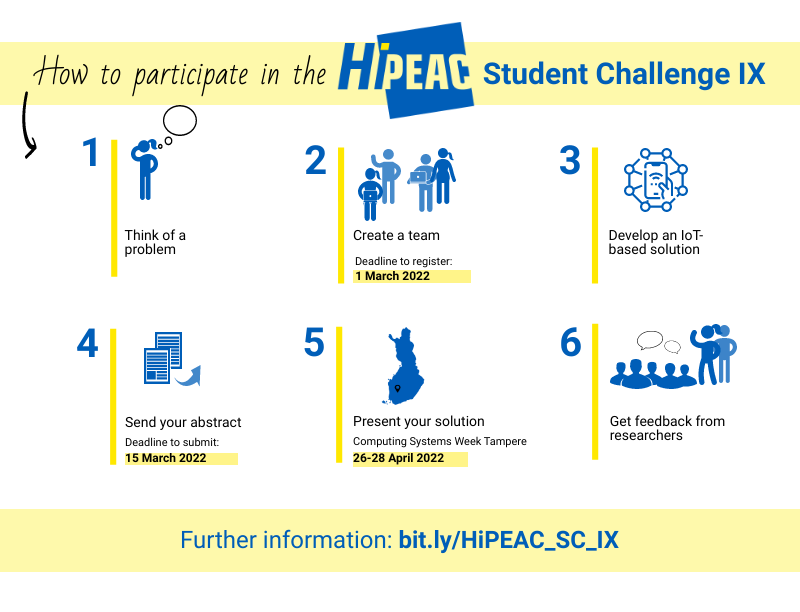
Once you’ve settled on a problem, ask a teacher or senior student to mentor your team (this step is not mandatory, but it may give you more confidence). Your team will work on a specific solution to the problem: either developing a new solution, if existing solutions aren’t suitable from your point of view; or basing your solution on one which already exists and trying to improve or update it. You will need to explain how your problem is solved by an IoT approach. There’s no need to deliver a full implementation, but you will need to set out the goals to achieve, along with a framework with the main parts which need to be implemented (it would be good to have a chosen platform, maybe a specific architecture, or anything else you clearly envision in your ‘product’). You’ll then send us an extended abstract (2-4 pages), explaining your strategy, how you overcame obstacles and why you think your solution works (or works better than others).
We’ll choose five teams to join us in Tampere, Finland for HiPEAC Computing Systems Week (26-28 April 2022); the rest can join us by video link.
Once your presentation is over, it’s again time to turn the tables. You’ll challenge a panel of senior researchers to give you feedback on your solution, as well as post their own solutions.
Travel grants are available to ensure that at least two people by the team can attend the HiPEAC event.
Don’t miss out – apply for the Student Challenge today!
Questions?
Ask the organizers - they’re here to help.
Marisa Gil, (UPC/BSC)
Işil Oz (İzmir Institute of Technology)
Chris Fensch, (Arm Norway)
Georgios Goumas (NTUA, Greece)
Raffaella Folgieri (University of Milan)
Important dates
- 1 March: Email the organizers to register your interest in attending. Send the names of your team members, your institution name, and the name of your advisor. Note: Only students can be team members.
- 15 March: Send your title, extended abstract (and preferred kind of presentation, by default we assume a live presentation).
- 25 March: We will contact you to say which kind of presentation (live or video) you’ve been selected for.
- 26 April: Present your results.