What made you decide to apply for a HiPEAC internship?
While working on my master’s thesis on computer architectures, I decided to join an internship to see what other people from industry or academia were doing in this field. My supervisor, Işıl Öz, told me about HiPEAC internships and through this programme I applied to the Sundance Beyond TULIPP opportunity.
Why did you choose Sundance?
I realized that working with the Vision Control Sensor (VCS) integrated circuit provided by Sundance would allow me to test processor architectures and deep learning applications. While I already knew how to code with the Verilog hardware description language (HDL), it was motivating for me to learn other unified application development environments provided by Xilinx. I also thought that thanks to Sundance’s presence on the international market, I could create a valuable network. Although I am familiar with the industry in my own country, it was exciting to get to know institutions in other countries, especially those working on low-level software and embedded technologies.
What key things did you learn?
As described in the Towards Ubiquitous Low-Power Image Processing Platforms (TULIPP) book, there has been a transition from current processors to the all-in-one platforms such as the VCS-1 board. The main reason for this is that the amount of data being processed is increasing day by day because image processing algorithms are becoming more widespread and algorithms are becoming more sophisticated, which requires more powerful cores to process increasing data with high performance.
I was aware that system-on-chip circuits had been used in recent years to meet different industry needs, but I did not know the architectural features of these circuits, the kinds of processor they work with and the memory speeds. This internship gave me the opportunity to learn about the processors and data processing speed of the Xilinx Zynq Ultrascale+ architecture, one of the most up-to-date and commonly used SoCs.
Xilinx has developed two comprehensive frameworks, Vitis and Vivado, to develop applications for reconfigurable hardware. Thanks to these, I was able to produce and synthesize any algorithm and see the simulation results. For simulations that run as expected, you can export the corresponding application and try it on the boards which had been previously specified. As a result, I learned to develop applications using Vitis and Vivado software environments where you can run the exported application from Vitis on Vivado.
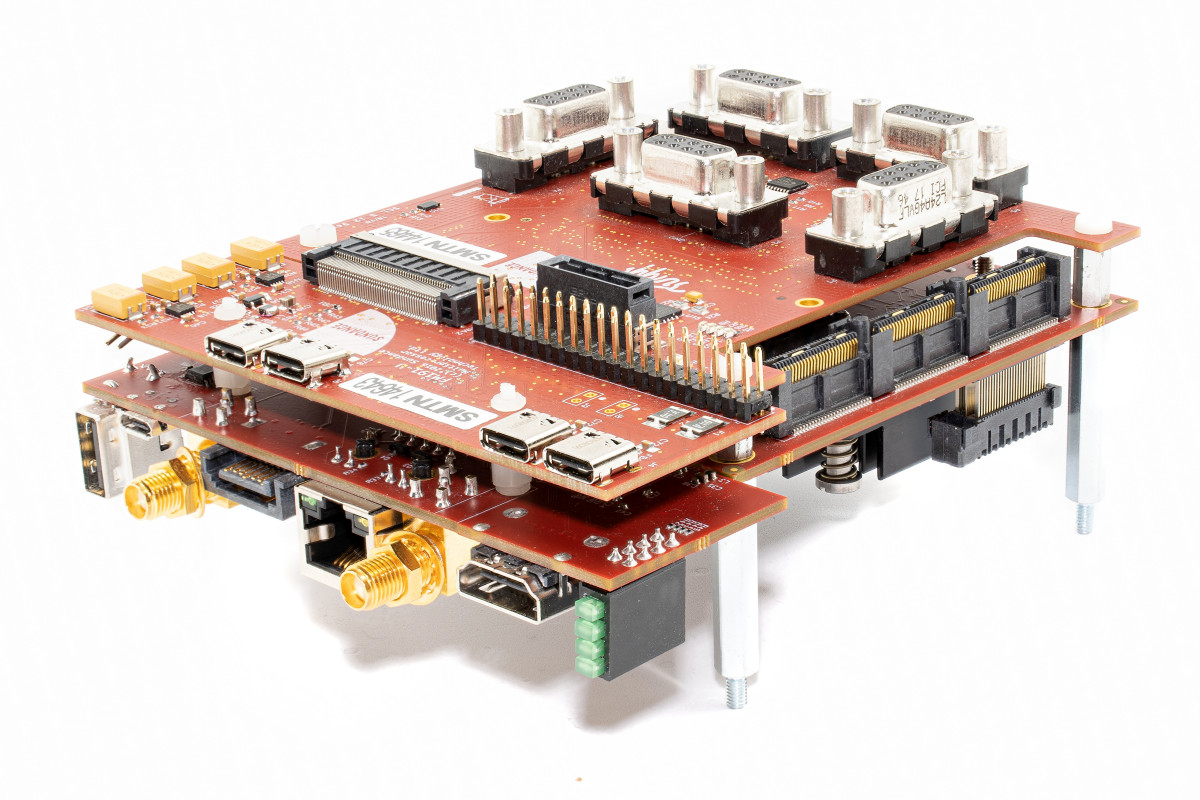
The Sundance VCS-1 board is an integrated circuit with various peripherals built around a Zynq SoC. Sundance also offers a LynSyn Lite module for runtime power profiling of embedded applications. The main topic of my internship was observing the the power consumption of an embedded application on the VCS-1 via LynSyn Lite. I also learned how to debug an application at runtime.
Some of the other technical knowledge I acquired during this internship was:
- how to work with the Petalinux operating system
- how the local computer communicates with the resource in the AWS EC2 cloud, and how to export an application developed in the cloud to a local Xilinx board via JTAG
- how to integrate the processing system (PS) and programmable logic (PL) to parallelize the application workload and increase performance
In addition to this technical knowledge, I also learned some non-technical things. This was the first time I had regularly attended meetings with an institution in a different country, as well as sharing my work and receiving remote feedback, and it has increased my motivation and self-confidence to work in an international context. I also managed to build a highly beneficial network with people close to the computer architecture topics on which I plan to build my future career.
What was the most challenging part of your internship?
There were a few challenges. Due to the COVID-19 situation, the internship was undertaken remotely, which often made active and dynamic communication difficult. Second, the software frameworks provided by Xilinx are challenging to install on standard computers: I needed to obtain an extra 100GB of space to install the application development software frameworks. Finally, I found developing an application and producing the correct bitstream confusing at first, as there were so many different software versions and so many different hardware chips.
What made you decide to take part in the HiPEAC Student Challenge in Lyon?
I wanted to attend Computing Systems Week Lyon to investigate current work related to computer architectures in more detail. The Histogram Equalization Student Challenge allowed me to present the results from my internship and to introduce myself to the community at Computing Systems Week. I thought it would be valuable to implement the histogram equalization algorithm, used to profile performance and power consumption, which could be evaluated in the TULIPP concept promoted by Sundance.
Participating in Computing Systems Week helped me in several ways. First, the jury’s comments at the Student Challenge helped enlarge our imaginations. Second, listening to the presentations at the event helped me familiarize myself with industrial applications and academic studies in computer architecture, embedded software and compilers. I also found out that I could follow the news of the community in the HiPEAC magazine. Finally, I also concluded that I could work with people located in different places where the goals overlapped; other attendees expressed their openness to collaboration ideas.
Read Burak’s full internship report on the Sundance Multiprocessor Technology website