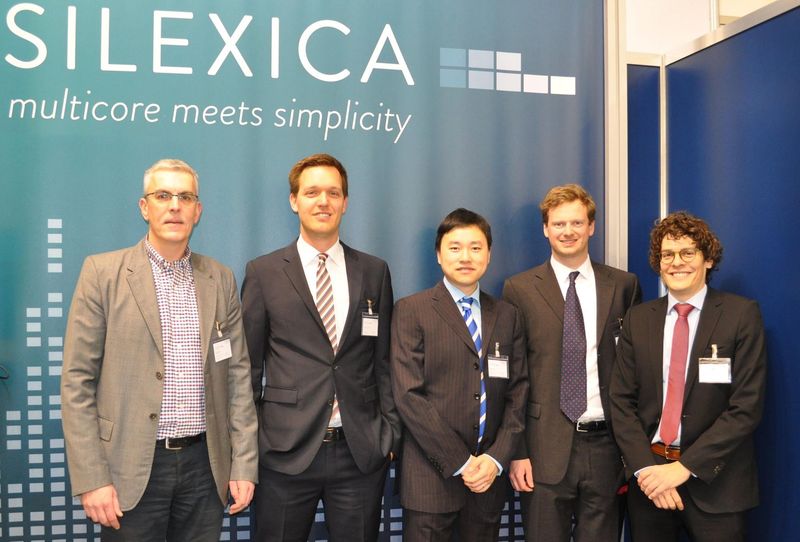
Congratulations on the acquisition! Let’s go back to the beginning. How did Silexica come about in the first place?
Rainer: We started this as an academic research project around 2007. It was clear that multicore architectures would be around the corner in virtually all embedded information and communication technology (ICT) domains, yet without proper software-development tool support. We had a lot of compiler technology and processor design knowhow from earlier projects and decided to take on the multicore programming challenge. After a series of fundamental PhD and master’s theses, the technology became mature enough to transfer, and even sell, to early adopters from industry.
Another important milestone was a hands-on workshop for potential customers in Aachen, which provided us with important feedback and gave us the confidence that we really were on the right track. At the same time, we had an ambitious and diverse founding team in place, with Max in the cockpit, which is equally important.
Max: We then successfully applied for an EXIST Transfer of Research grant, provided by the German federal government, which supports outstanding research-oriented projects that involve expensive and high-risk resource development. This allowed us to spin off the company, transfer the intellectual property (IP) and hire an initial team. So we didn’t start from zero, and this enabled us to secure funding to continue building the team quite soon after the foundation.
What made the product offer stand out?
Rainer: I have seen quite often that programming tools for new hardware architectures are just an afterthought. The semiconductor market history is full of examples of powerful, yet ’unprogrammable’, hence unusable, chips without business success.
Our mission was to enable software developers to really take full advantage of the forthcoming heterogeneous multicores. We were able to demonstrate that this worked for complex real-life products, such as the Samsung Galaxy S6, which was among our first target devices. Another important use case was the ability to perform hardware/software co-optimization based on virtual prototypes, long before the actual hardware would be taped out.
Max: We were – and still are – the only ones not just using static code analysis, but also adding dynamic source code analysis of an application. This means we actually execute the application, enabling much deeper analysis capabilities. More data leads to improved application speedup and better actionable insights, with even more automation opportunities in the future.
How did you manage the process of setting up the company? What lessons did you learn in the process?
Rainer: Fortunately, RWTH Aachen is a very founder-friendly university. Our institutes and upcoming startup teams enjoy a lot of entrepreneurial freedom. A key aspect is always to get the IP transfer right in legal terms, because investors will be sensitive to that. I had some experience from a previous spin-off (LISATek), so I knew the major steps, and altogether the process was very smooth in my view.
Nowadays it’s probably even easier thanks to the recent foundation of RWTH Innovation GmbH. This provides a one-stop shop for founders and avoids the need for knocking on the doors of various administration departments and getting all their OKs. Universities aiming at boosting their technology transfer rate should definitely put more trust in the founding teams and eliminate bureaucratic strings.
Max: I think all the usual pitfalls of a technical university spin-off applied to us. Talking way too much about technical features instead of customer benefits, understanding product-market fit but not product go-to-market fit, hiring lots of engineers without proper product management support, scaling sales too early; the list continues.
If I had to pick one, I think a true lesson was getting a real understanding of the holistic approach of marketing and what it includes: not just corporate marketing, but also product planning, product management and product marketing. So I would definitely recommend talking to lots of people, listening carefully and getting some experienced startup founders or executives as mentors who’ve been on this journey already and understand the challenges associated with building something from the ground up.
What was the most challenging aspect about setting up the company? Were there times when you felt like giving up?
Max: I think there are challenges every single week, from negative feedback from a customer, to the key hire you didn’t make, a last-minute budget cut from your largest customer or a worldwide pandemic. But there are lots of rewarding moments every week as well, such as securing a big deal, hiring someone who will bring you to the next level and seeing your strategy actually working. Ultimately, you need the conviction that your product or solution is needed and you are on the right path. And even though we had various pivots throughput the years, giving up was never an option.
Do you have any tips on how to scale up a company?
Rainer: That´s a tough question. Is it better to have a big piece of a small cake or vice versa? I have seen various companies that bootstrapped slowly, without major investment rounds, over a long period and that eventually had a very profitable exit. On the other hand, if your initial ambition is a unicorn, then fast growth is a must. In deep tech particularly you need international presence, and that in turn implies scaling up as soon as possible. In the end, it’s a matter of the team’s attitudes and opportunities popping up along the way.
Max:I think it is key to sit down right from the start with your team and discuss what type of company you want to be. Why you exist in the first place, how you fit into your customers’ value chain, what niche you can win first, how to expand, and what the overall ambition and vision of the company is. Then go backwards to plan how to get there: what milestones do we need to hit, what kind of team do we need, when do we need money and how much do we need to execute that plan.
Ensuring that your product strategy and cooperate strategy are always well aligned and feed off each other – such as hitting important product or customer milestones – is also important in order to raise the next round of funding (assuming you are on a growth track backed by venture capital).
What was the company’s exit strategy? Did you ever have any plans to go public?
Rainer: Initial public offerings (IPOs) in deep tech are risky, costly and tedious, thus pretty rare these days. So the basic options left are to establish a self-sustainable new long-term business or to target an attractive acquisition by a larger corporation. Venture capital firms, with their fixed-term investment funds horizon, clearly have a preference for the latter, and this is how Silexica exited. My advice to founders would be to focus on the business development, while ensuring maximum visibility and just enjoying the day-to-day fun in ramping up the company. Serious exit considerations will follow automatically when the time is right.
Max: I think the various options were clear from day one, and we didn’t exclude anything there, from being acquired by a semiconductor company, becoming a new electronic design automation (EDA) player or doing an IPO. We indeed did have interesting discussions around the creation of a special-purpose acquisition company (SPAC) – a shell company created to acquire a private company – at the same time we were having merger and acquisition (M&A) discussions. But Rainer is absolutely right: the key focus should be on adding customer value and showing why you exist; everything else will slot into place.
What are you most excited about for the future? How do you think the Xilinx buy out will help Silexica develop in the future?
Rainer: Some people remarked that they don´t like to see European Union (EU) startups often being acquired by companies from the United States. In my view, they often overlook we are living in a very globalized world. It’s also not unusual for EU companies to perform overseas acquisitions as well. At the end of the day, what counts is where new workplaces are created and where taxes are paid to serve our economy. In that sense, the acquisition is a great move, hopefully inspiring many future HiPEAC founding teams.
Max: I think this acquisition is a perfect example of this kind of boost to the local economy. Software programmability is imperative to Xilinx’s long-term goal to accelerate the path from software to application-optimized hardware systems. The Silexica technology complements the existing solution and roadmap and will accelerate their roadmap to attract software developers.
Starting with our existing stellar team, we are now planning to grow the Cologne office significantly in the future and build a centre of excellence for compilers, machine learning and artificial intelligence more generally. Anyone with an interest and expertise in those areas, please check out our open positions or reach out to me.