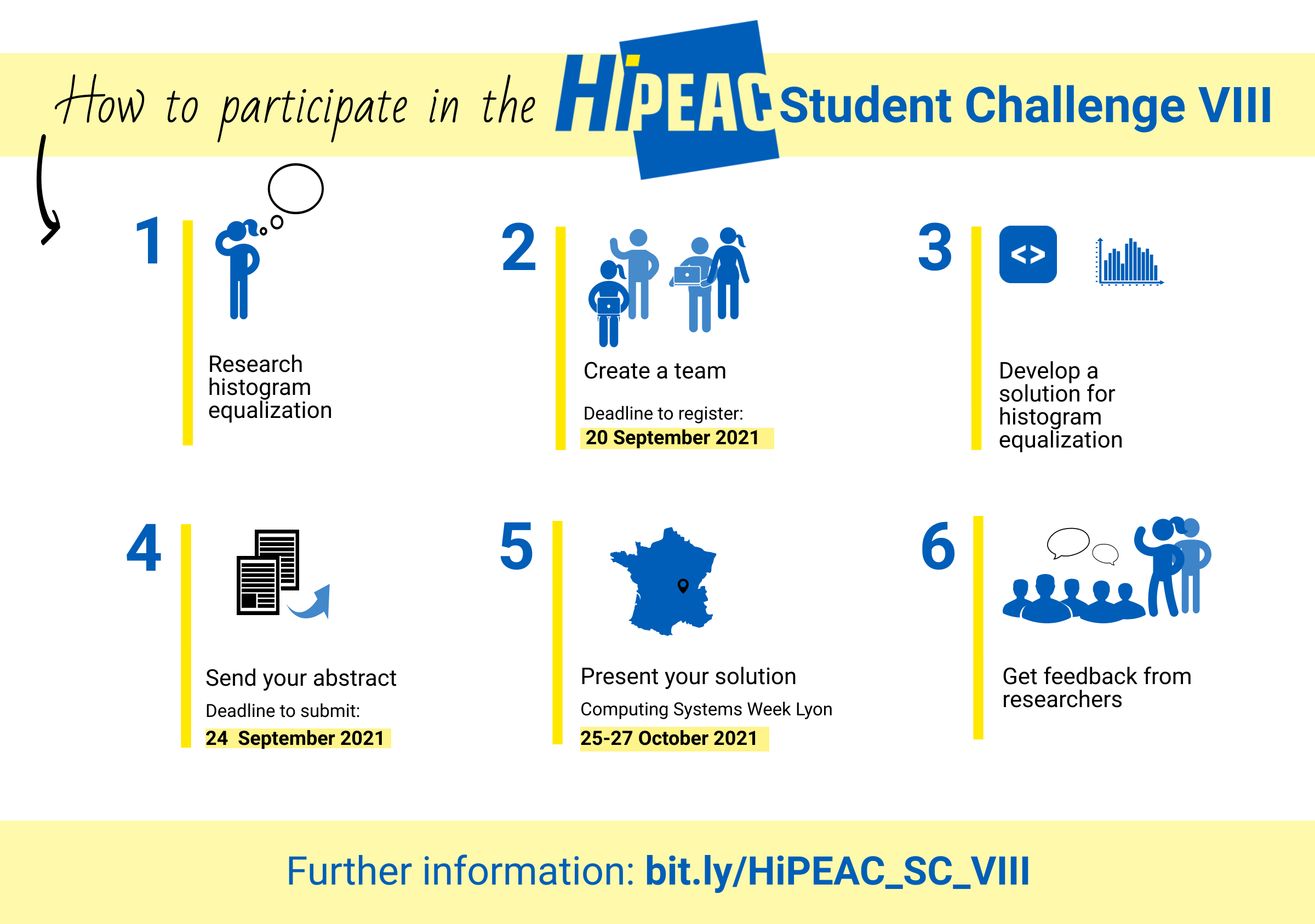
In this HiPEAC Student Challenge, we’re looking for teams of computer science students (or similar disciplines) – whether undergraduate, master’s level or PhD – to come up with a digital solution to the problem of:
Histogram equalization
(basic or advanced)This method is often used to increase the global contrast in images or any kind of data. However, potential downsides of the basic method is that it not only increases the contrast of the signal, but also the contrast of the background noise. It might create unrealistic effects in images. A good starting point for the basic technique and more advanced versions is Wikipedia.
Your challenge will be to define your precise problem and then solve it. For example:
- Implement a version of histogram equalization on a platform of your choice (preferable parallel).
- Pick a more advanced version and use machine learning techniques to tune this version to achieve the best results.
- Develop a new variance of histogram equalization.
Or anything else that involves or utilizes histogram equalization.
First, you will need to investigate the problem and existing implementations. After that everything is up to you. Choose an algorithm. Choose a platform. Choose an implementation. Choose a framework.
After you have optimized everything there is to optimize, we would like you to prepare a short presentation explaining your strategy and how you would overcome obstacles. There’s no need to deliver a full implementation, but you will need to set out the goals to achieve, along with a framework with the main parts which need to be implemented.
You’ll then send us an extended abstract (2-4 pages), explaining your strategy, how you overcame obstacles and why you think your solution works (or works better than others).
We’ll choose five teams to join us in Lyon, France for HiPEAC Computing Systems Week (25-27 October 2021); the rest can join us by video link.
Once your presentation is over, it’s again time to turn the tables. You’ll challenge a panel of senior researchers to give you feedback on your solution, as well as posting their own solutions.
Travel grants are available to help team members attend the HiPEAC event. There will also be a diploma for all the teams and prizes available for the most challenging problems and the best presentation.
Don’t miss out – apply for the Student Challenge today!
Important dates
- 20 September: Email the organizers to register your interest in attending. Send the names of your team members, your institution name, and the name of your advisor. Note: Only students can be team members.
- 24 September:Send your title, extended abstract (and preferred kind of presentation, by default we assume a live presentation).
- 28 September: We will contact you to say which kind of presentation (live or video) you’ve been selected for.
- 25-27 October:Present your results (the exact date will be announced once available).