The challenge
So what's the challenge? It's up to you! It could be:- improving a situation (transportation, work, study, environmental, etc.)
- facilitating a task (search, movement of material, storage, ordering, organization, etc.)
- or any other scenario where something could be improved…
- An internet-based solution to promote socializing by older people.
- Making agricultural irrigation systems more water efficient.
- System alarms to share information among neighbours.
Or check out some of the examples from previous editions, such as the Student Challenge VI in Edinburgh or the Student Challenge V in Heraklion.
How to take part
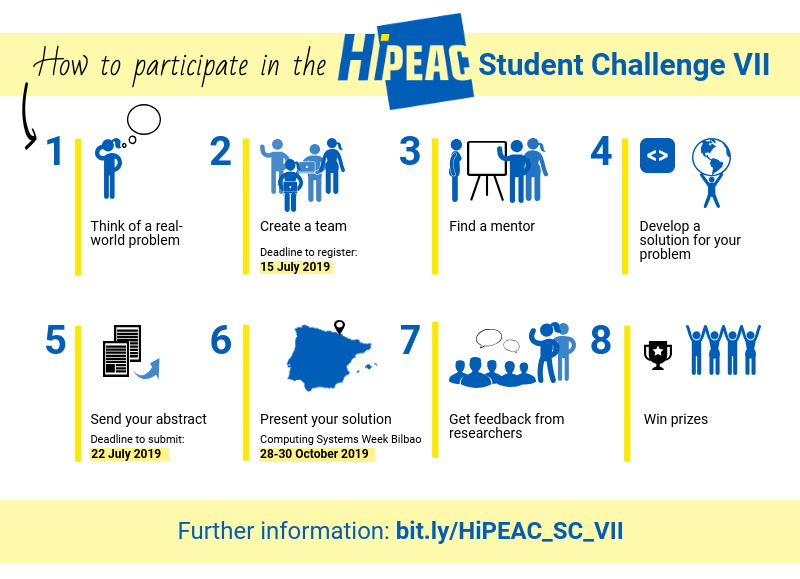
- Find a team and register by emailing the Student Challenge organizers (below). The deadline for registrations is 15 July
- Define a concrete, real-life problem (see above for ideas).
- Ask a teacher or senior student to mentor you (this isn't mandatory, but may give you more confidence).
- Work on a specific solution to this problem; either a new solution, or one based on something which already exists. You will need to explain:
- why it is important to solve this chosen problem for your daily life
- what makes your solution suitable
- how the data involved is managed: whether a lot of data is needed at a given time or for a period of time, whether the data will be distributed over different locations, whether the data is in different formats, and so on
There’s no need to deliver a full implementation, but you will need to set out the goals to achieve, along with a framework with the main parts which need to be to implemented (it would be good to have a chosen platform, maybe a specific architecture, or anything else you clearly envision in your 'product'). - Send us an extended abstract (2-4 pages). Explain your strategy, how you overcame obstacles and why your solution works. The deadline for abstracts is 22 July.
- We’ll choose five teams to join us in Bilbao, Spain for HiPEAC Computing Systems Week (28-30 October); the rest can join us by video link.
- Once your presentation is over, it’s time to turn the tables. You’ll challenge a panel of senior researchers to give you feedback on your solution, as well as letting you know how they would solve this problem.
Important dates
15 July: Email the organizers to register your interest in attending. Send the names of your team members, your institution name, and the name of your advisor. Note: Only students can be team members.22 July: Send your title, extended abstract (and preferred kind of presentation, by default we assume a live presentation).
31 July: we will contact you to say which kind of presentation (live or video) you’ve been selected for.
28-30 October: Present your results (the exact date will be announced once available).
Questions?
Ask the organizers - they're here to help.Marisa Gil, Universitat Politècnica de Catalunya / Barcelona Supercomputing Center
Chris Fensch, Arm Norway
Georgios Goumas, Institute of Communication and Computer Systems, National Technical University of Athens
Isil Oz, İzmir Institute of Technology