The problem for this edition’s challenge is… the conjugate gradient method. A good introduction to this method can be found in this paper. You should have no problem finding several reference implementations for various systems. Please keep in mind that the solution should consider the type of matrix (sparse, diagonal, dense, etc…).
First, you will need to investigate the problem and existing implementations. After that everything is up to you. Choose any type of matrix. Choose an algorithm. Choose a platform. Choose an implementation. Choose a framework. After you have optimized everything there is to optimize, you need to prepare a short presentation explaining your strategy, overcome obstacles and show how fast it now runs.
Then it will be time to pack your bags and join us in Gothenburg to present your results at the innovation-themed Computing Systems Week (22-24 May), where you will be able to discuss your results with HiPEAC students from all of Europe. In addition, a panel of senior HiPEAC members from industry and academia will give you feedback on your approach.
In order to give every HiPEAC university a chance to present their results, we would like to ask you to create no more than two teams per university and select a leader to present the results (either in person or via a video link). Each team can implement as many different approaches as they like and present them in one brief presentation. Please contact us if you would like to form multiple teams per institution or a team with members from different institutions.
As in previous events, we hope that we can provide some financial assistance for team leaders to attend the event in Gothenburg. In any case, we strongly encourage the full team to join us at the Computing Systems Week. You’ll have the opportunity to hear from some great keynote speakers, attend thematic sessions and workshops, and participate in the social event. We will prepare a special student track with an “Inspiring futures!” career mentoring session, giving you information about career, PhD and internship opportunities. You’ll also have the chance to meet and interact with the top computing experts in Europe. All this and much more!
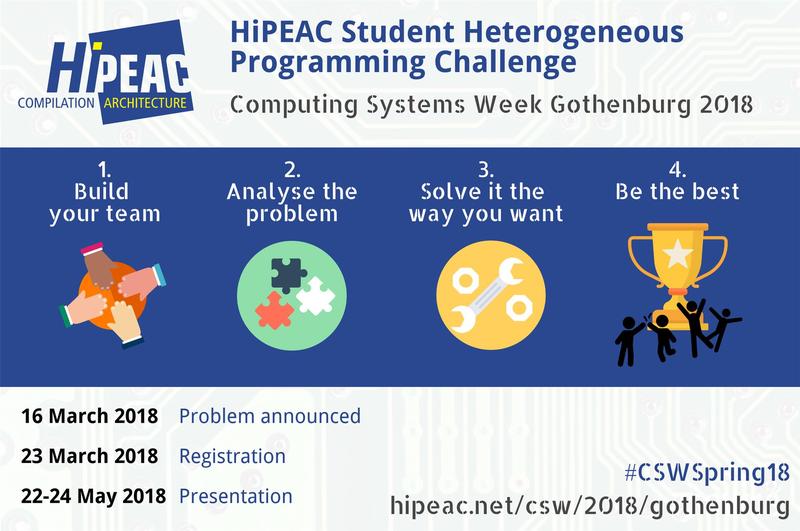
Important dates:16 March: We will announce the problem.
23 March: Register your team (send an email to the organizers with team name, members and emails, and how you plan to present the results). Organizers: Chris Fensch, Marisa Gil and Georgios Goumas.
22-24 May: Present your results (the exact date will be announced once available).
Questions? Email [email protected]